How to Create Mini Program 3D: Process, Toolchain, and Delivery Standards
Mini Program 3D refers to a lightweight solution for rendering 3D content within a mini program runtime environment, suitable for product display, interactive marketing, virtual showrooms, and similar scenarios. As of 2026, there are three mainstream paths: Three.js/WebGL, Unity export, and third-party platforms. Key delivery metrics include first-screen loading within 3 seconds, an average frame rate of no less than 30 FPS, and a resource package as small as possible. This article provides an executable workflow, a selection comparison, and acceptance criteria.
What Is Mini Program 3D: The Practical Choice for Lightweight Rendering
Mini Program 3D does not mean cramming a full 3D application into a mini program. Instead, it involves selecting an appropriate solution based on runtime environment constraints. WeChat Mini Program's Canvas 2D/WebGL interfaces can support basic 3D, but memory and package size limits still apply. Suitable scenarios typically feature short interaction paths, controllable model polygon counts, and a single scene.
- Typical types: 360° product display, spatial preview, interactive mini-games, AR try-on.
- Main constraints: memory limit of approximately 500MB, main package of 2MB, resource subpackage of about 20MB, and no support for plugin-level GPU features.
Unlike 3D on regular web pages, mini programs have platform review and API restrictions. Asset compression and code splitting are mandatory, so you cannot directly port PC workflows.
Production Process: A Four-Step Implementation Method
Project implementation follows four steps, each step's output directly affects the next.
- Define requirements and specifications: Confirm core interactions, target platforms, and the lowest-end device model, and set limits for polygon count, textures, and loading.
- Prepare 3D assets: Control triangle count, export as glTF/GLB, and compress. For product models, keep triangle count under 100,000; for scene models, under 500,000.
- Select technology and implement: Choose Three.js, Unity, etc., based on team capabilities, and write interaction and camera controls.
- Integration testing and optimization: Run on real devices, adjust textures, compress files, and enable fallback strategies.
In the requirements phase, clarify the device range. In the asset phase, verify sizes. In the testing phase, record frame rates. A common mistake is ignoring the target device model—use the lowest-end device as the performance benchmark.
Toolchain Selection: Three.js, Unity, or a Third-Party Platform?
By 2026, the toolchain is quite mature. The key to selection is matching project scale and team skills. A comparison of the three options:
- Three.js/WebGL: Suitable for projects with simple models and controllable interactions. Package size is smaller. A simple display takes about 2-3 weeks to develop, with the main cost being front-end engineering hours.
- Unity export: Suitable for projects requiring complex real-time rendering or physics simulation. Package size is larger. The cycle is about 1-2 months and requires a game development background.
- Third-party platforms: Visual configuration, fast to launch, but low flexibility, high data integration costs, and typically annual subscription fees.
If the focus is product display with low polygon counts, consider Three.js first. For physics collisions or large scenes, Unity is more appropriate. Before selection, load a medium-complexity model on existing devices and compare loading speed and frame rate.
Performance Optimization and Common Rework Reasons
A common pitfall is moving PC assets into the mini program unchanged. Frequent causes of rework include: excessive polygon counts leading to white screens, oversized textures slowing loading, insufficient baked lighting, and low frame rates on real devices. Optimization order:
- Models: Remove hidden faces, merge meshes with the same material, and simplify polygon counts.
- Textures: Compress to ASTC or ETC2, keep dimensions under 2048, and use texture atlases for repeated textures.
- Rendering: Use baked lightmaps instead of real-time lights.
- Loading: Load on demand, use subpackages, and download 3D resources asynchronously.
To verify optimization, run continuous interaction for 2 minutes on the lowest-end device. The average frame rate should be at least 25 FPS, and at least 30 FPS on regular devices. Rework often occurs when assets are imported directly from 3D software into the mini program. Before export, check plugin versions and materials.
Delivery Standards and Acceptance Metrics
A qualified delivery should have a quantifiable checklist:
- First-screen loading: On the lowest-end test device, the model outline appears within 3 seconds.
- Frame rate: At least 30 FPS on regular devices, and at least 25 FPS on the lowest-end device.
- Package size: 3D code and assets in the main package should not exceed 2MB; resource subpackage should not exceed 20MB.
- Stability: Continuous operation for 30 minutes on target devices without crashes or white screens.
Acceptance is performed in two steps: first, art review of visual quality; second, test engineers run a performance report on real devices. If the deliverable is only claimed as “it runs,” be cautious.
Applicable Scenarios and Boundaries
Suitable cases: Product displays, brand interactions, and educational demonstrations with low polygon counts, short interaction paths, and single-session experiences under 5 minutes.
Unsuitable cases: Scenarios requiring extensive resource downloads, multiplayer, professional CAD real-time operations, or high-frequency continuous interaction. For such needs, consider a mini game or standalone App instead.
To decide whether to use Mini Program 3D: Must users complete the 3D experience within the mini program? For mere display, pre-rendered videos or image sequences are cheaper and faster to load.
Frequently Asked Questions
What is the typical production cycle for Mini Program 3D? What factors affect quotes?
Simple displays usually take 2-3 weeks; complex scenes take 1-2 months. Quotes are affected by model complexity, number of interactions, and the scope of real-device adaptation.
Do Mini Program 3D modeling and rendering need to be done separately?
Yes. You first create the model, then import it into a real-time engine or WebGL for baked rendering. Pure rendered still images are not applicable to mini programs; real-time rendering must balance frame rate.
What is the difference between rendered still images and Mini Program real-time rendering?
Rendered still images allow fine-tuning. Mini Program real-time rendering is constrained by hardware performance, requiring a trade-off between visual quality and frame rate.
What file formats should be delivered for Mini Program 3D?
Usually, you deliver the mini program project source code, 3D source files (e.g., blend/fbx), and glTF/GLB assets, along with deployment documentation and a performance test report.
Is Mini Program 3D suitable for large complete showrooms?
No, it is not suitable for large complete showrooms. It works for small standalone product-level scenes. Large projects need to be split into multiple scenes or use a mini game solution instead.
Implementation advice: First, select the tool path based on model complexity; keep glTF/GLB intermediate assets during production; and test on low-end real devices before launch. If the budget is limited, a third-party platform can be a good starting point.
-
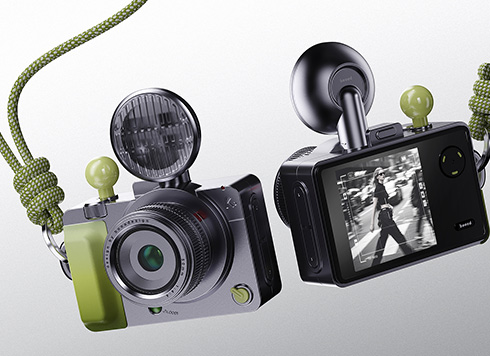 EDC·Trendy Camera Product Design: Form Follows Emotion
EDC Toy Camera: Braun-inspired retro design ...
-
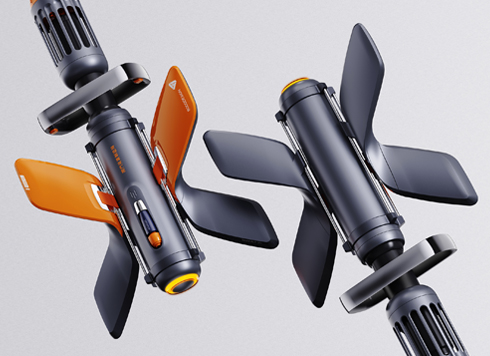 Product Design of Children's "Bubble Rocket" Underwater Thruster
Inspired by "Octonauts + Space", kids' "Bub ...
-
 Design of Adaptive Intelligent High-Altitude Shuttle Transport Robot
Smart rural shuttle bot: Streamlined, weath ...
-
 "Effortless" Exoskeleton Wear: Unleash Ultimate Freedom in the Sea
"Unfelt Wearability" & "Bionic Power" redef ...
-
Mini Program 3D First Screen Blank for Seconds, Textures Already at 1K but Still Slow—Is Model Polygon Count Not the Issue?
Date: Sep 30, 2026 Read: 40
-
Mini Program 3D Display: Rendered Images vs Real-Time Engines – What's the Difference, Delivery Time, and Where Does Rework Happen?
Date: Aug 21, 2026 Read: 117
-
A Complete Guide to Mini Program 3D Production: From Modeling to Rendering Delivery Standards
Date: Jul 27, 2026 Read: 130
-
Mini Program 3D Rendering in Practice: A Full-Process Guide from Zero to Delivery
Date: Jul 14, 2026 Read: 161
-
Why does mini-program 3D start smooth on a budget Android phone but get hot and drop frames after two minutes?
Date: Oct 14, 2026 Read: 7