




Three Key Stages and Common Pitfalls of Mini Program Development
In 2026, the key to successful mini program development lies in systematically going through three core stages: requirements analysis, technology selection, and iterative optimization, while avoiding common selection and implementation pitfalls. This article provides a practical framework to help teams make rational decisions based on project characteristics and avoid blindly following trends.
Pre-development Needs Assessment and Definition
In 2026, the first step in mini program development is to clarify business goals and user scenarios. Many projects fail because they skip needs assessment and jump directly to design. It is recommended to spend one to two weeks before development to complete three tasks: list core functions, define target user personas, and define key success metrics (e.g., daily active users, conversion rate). This can effectively reduce rework in later stages.
The criterion for determining whether needs assessment is sufficient: deliverables should include a feature priority matrix and user flow charts, and be confirmed by at least three parties (product, tech, business). A common pitfall is equating "desired features" with "required features," leading to doubled development cycles.
- Core Feature List: Distinguish MVP from Phase 2 features, marked using the MoSCoW method.
- User Personas: Define the usage paths of at least 2-3 typical users.
- Success Metrics: Quantifiable and trackable, e.g., first load time under 3 seconds.
Four Comparison Dimensions for Technology Selection
Technology selection directly impacts development efficiency and user experience. In 2026, mainstream options include native frameworks, cross-platform solutions (e.g., uni-app, Taro), and WebView wrappers. It is recommended to compare across four dimensions: user scale, performance requirements, development cycle, and budget cost. The weight of each dimension can be adjusted per project, but a comparison document should be prepared for decision-making.
Below is a set of comparable data based on common market ranges in 2026:
- Native Development: Cost 120,000-500,000 RMB, cycle 8-16 weeks, suitable for high performance and millions of users.
- Cross-platform Development: Cost 50,000-300,000 RMB, cycle 6-12 weeks, suitable for medium scale and non-extreme performance requirements.
- Template/Low-code: Cost 5,000-30,000 RMB, cycle 1-4 weeks, suitable for simple display or prototype verification.
For example, for an e-commerce mini program requiring ultimate smoothness, native development is more appropriate; for tool or content display mini programs, cross-platform solutions can deliver an initial version in three days. Note that template solutions may double costs during later expansion.
Key Control Points during Development
When entering the development phase, it is recommended to follow the principle of "agile iteration, weekly delivery." Each development cycle (usually two weeks) should include design reviews, code reviews, and test acceptance. In 2026, many teams use CI/CD pipelines, with smoke tests triggered automatically on each commit.
Commonly overlooked speed optimizations during implementation: lazy loading of images, skeleton screen pre-rendering, and API caching strategies. A qualified control point checklist should include: load time, error rate, memory usage. If a function module's memory usage exceeds 50MB, timely refactoring is needed.
- Design Review: Confirm UI fidelity and interaction consistency.
- Code Review: Focus on data security and API call frequency.
- Test Acceptance: Cover boundary conditions and network anomaly scenarios.
A real case: during the mid-development of an e-commerce mini program, the homepage first-screen load time exceeded 5 seconds. By switching the main API to CDN pre-caching, it was reduced to 1.8 seconds.
Applicable Scenarios and Boundaries
Custom mini programs are most suitable for the following scenarios: clear differentiated functional needs, vertical user groups, and deep integration with existing enterprise systems (e.g., CRM, payment). According to project delivery habits in 2026, the custom development cycle is usually 6-12 weeks, with a budget range of 100,000-500,000 RMB.
Scenarios not suitable for custom development: functions highly overlapping with existing market templates (e.g., simple information display), budget below 50,000 RMB and delivery time under two weeks, and the team lacks subsequent O&M capabilities. In such cases, SaaS platforms or template customization may be considered, with lower cost but poor scalability.
Boundary statement: Custom development is not a universal solution for all mini programs; when business logic is simple and user volume is small (daily active users below 1,000), template solutions offer better cost-effectiveness.
Frequently Asked Questions
How long does custom mini program development take?
Typically 6-12 weeks; under agile development, a usable version is delivered every two weeks, which is common among teams in 2026.
How to choose a development team?
Look at peer cases, request performance data (e.g., load time, crash rate) from past projects, and schedule technical interviews to assess communication efficiency.
Is maintenance needed after the mini program goes live?
Yes, at least one feature iteration or security update per quarter; it is recommended to reserve 15%-20% of the annual budget for O&M.
Which is more cost-effective: custom development or template development?
Templates have lower short-term cost (5,000-30,000 RMB) but are difficult to customize; custom development has high upfront investment but good long-term scalability, suitable for ongoing projects.
Can custom and template approaches be mixed?
Yes, custom core modules and non-core pages using templates, but attention should be paid to component compatibility and code maintenance costs.
Action guide: If you are planning a mini program project, we recommend starting with needs assessment to form clear requirements documentation; then compare technical solutions using the "four-dimensional selection method" to choose the right path; during development, focus on iteration pace and performance control. The above framework applies to most custom scenarios, but if your project budget is below 30,000 RMB or the cycle is shorter than four weeks, first evaluate whether template or SaaS solutions meet core needs.
-
 Well-Recognized Custom E-Commerce Mall System Dev
The Good Shopping mini-app is natively buil ...
-
 Anhui Huixiang Vegetable Garden Agricultural Products Mini Program v2.0 Iteration Development
HuiXiang MiniApp V2.0: Upgraded homepage, n ...
-
 Kunshan TrialBook Mini-Program Custom Development
This project developed an English-only Tria ...
-
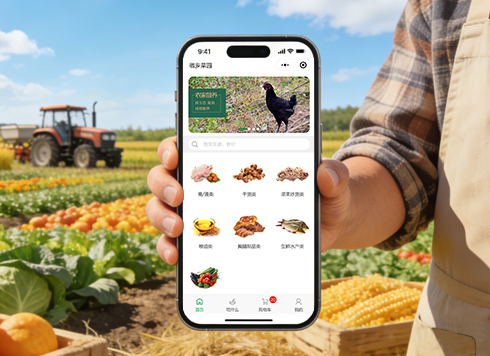 Agricultural Products WeChat Mini Program Custom Development
Lvran Di enhances agricultural sales via a ...
-
How to Develop a Custom Mini Program? Process, Selection, and Common Pitfalls
Date: Aug 1, 2026 Read: 144
-
Mini Program Custom Development: Process, Options, and Common Pitfalls
Date: Aug 11, 2026 Read: 100
-
How to Choose Custom Mini Program Development: Evaluation Process, Cost Structure, and Common Pitfalls
Date: Aug 9, 2026 Read: 113
-
Mini Program Development Selection Guide: Core Knowledge from Requirements to Launch
Date: Aug 7, 2026 Read: 125
-
Custom Mini Program Development: A Full-Process Guide from Requirements to Launch
Date: Aug 6, 2026 Read: 147