





Full-Link Digital Mini Program Solution for High-End Custom Liquor
The core value of this solution lies in: for enterprises, standardized workflows and automated workflows drastically cut communication costs and operational risks while boosting business processing efficiency; for customers, visualized interaction and real-time status synchronization reshape service experience and foster deep trust; for managers, multi-dimensional data dashboards and intelligent early warning mechanisms empower data-informed decision-making, enabling management transformation from "experience-driven" to "data-driven". Ultimately, it helps enterprises build a modern customized liquor business system featuring high efficiency, full transparency, traceability and scalability, laying a solid foundation for large-scale business expansion.
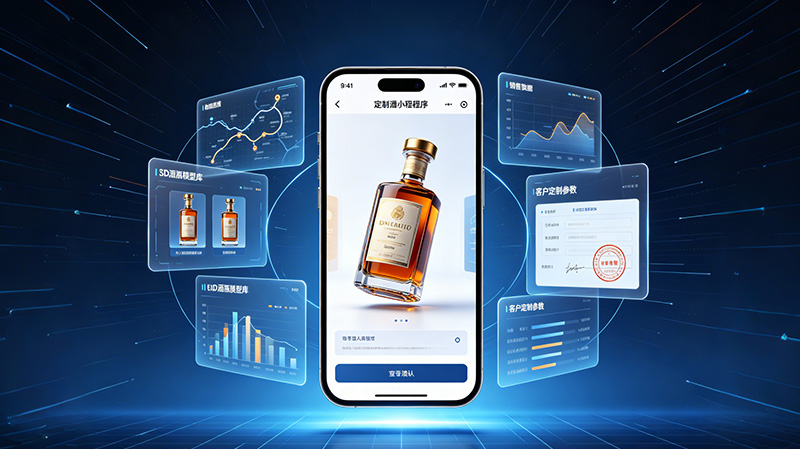
1. Project Overview & Business Pain Points
1.1 Industry Pain Point Analysis
Currently, the high-end customized liquor sector generally faces the following core challenges, which severely hinder standardized and large-scale business development:
-
Complex & inefficient communication links: The business chain covers sales, design, production, logistics, clients and other stakeholders. Traditional offline communication via phone calls and instant messaging tools (e.g. WeChat) easily causes distorted information transmission and biased demand comprehension, forming "information silos".
-
Blind spots in process control: The entire workflow from demand submission to final delivery lacks standardized system governance. Order status is opaque, responsibility allocation ambiguous, and abnormal events untraceable, frequently triggering order errors & omissions, repeated scheme revisions and delivery delays.
-
High risk exposure for custom demands: Rigid constraint mechanisms are absent in critical links including demand confirmation, scheme design and material compliance review. Verbal agreements and unstandardized document transfers create hidden troubles for subsequent disputes, bringing operational losses and brand reputation damage to enterprises.
-
Lack of data support for managerial decisions: Business data is scattered across all participants, hard to aggregate and analyze. Executives cannot grasp the full business picture in real time, so operational decisions rely on personal experience without accurate, timely data references.
1.2 Overall Solution Framework
To address the above pain points, this solution proposes building an end-to-end digital management platform "customer-centric, process-driven and data-connected". Its core framework is as follows:
-
Onlineization: Migrate full business workflows online to enable real-time info sync and efficient circulation.
-
Standardization: Convert unstructured demands into structured forms and solidify unstandardized workflows into system nodes.
-
Visualization: Deliver full transparency of order progress, production status and logistics tracking for both clients and managers.
-
Intelligentization: Adopt rule engines and AI tech to realize intelligent review, risk early warning and decision support.
2. Core Functional Architecture & Detailed Design
Centered on the full lifecycle of customized liquor orders, the system develops and implements the below core functional modules, forming a closed-loop digital workflow from customer engagement to final delivery.
2.1 Standardized Online Order Placement Module
This module completely replaces fragmented traditional communication modes, delivering a clear, efficient and standardized self-service ordering experience for clients, and guaranteeing accuracy & integrity of order data from the source.
-
Structured demand collection forms: Disassemble scattered complex demands including liquor type selection, capacity specs, packaging materials, custom copy content, design style preferences and recipient info into standardized form components such as drop-down menus, single/multi-select buttons and date pickers. Structured input enforces mandatory collection of key info, effectively eliminating info omissions and ambiguities caused by verbal talks or free-text input.
-
Intelligent rule engine & real-time verification: Built-in system verification rules intervene and guide users during form filling. Examples include format validation for mobile & email fields, word count limits for custom copy, mandatory upload of print-compliant materials (300DPI resolution, transparent PNG) plus online preview functions to help clients self-check material quality pre-submission, securing downstream printing effects at source.
-
Dynamic pricing calculation & instant feedback: The system calls the pricing engine in real time to dynamically compute total order value based on selected configurations (liquor SKU, packaging options, craft complexity, etc.). All discounts and promotions are automatically combined and clearly displayed for full price transparency, enabling clients to fully understand cost breakdowns at decision-making stage and significantly lifting ordering efficiency & trust.
2.2 Intelligent Order Review Module
Right after order submission, the system triggers a mandatory dual-review process of "system pre-review + manual recheck" to conduct multi-dimensional compliance and feasibility validation, intercepting production risks in advance.
-
Info integrity validation: The system auto-scans all core order fields to ensure complete delivery addresses, product configurations and custom requirements, preventing production halts or delivery failures from missing basic data.
-
Material compliance auto-inspection: Image recognition tech analyzes uploaded design files and auto-checks resolution, color mode (CMYK), file format, dimension ratio and other production criteria. For non-compliant files, the system clearly marks defects and provides revision guidelines.
-
Content compliance risk screening: NLP (Natural Language Processing) tech auto-scans custom text for sensitive words, prohibited terms and copyright-infringing keywords to strictly control content safety and avoid legal & brand reputational risks.
-
Production capacity & craft feasibility assessment: Backend system syncs real-time factory capacity and equipment status. During review, the system intelligently evaluates delivery cycle feasibility based on current production schedules, material inventory and special craft complexity (hot stamping, UV printing, embossing, etc.), providing reliable grounds for sales delivery commitments.
-
Auto workflow routing & closed-loop revision for review results: Approved orders are auto-pushed to production scheduling systems to generate standardized production work orders and trigger material preparation. Rejected orders receive auto notifications with detailed rejection reasons, revision suggestions and reference samples; clients can edit and resubmit within the original order, with all operations logged for full traceability of responsibilities.
2.3 Online Scheme Confirmation & E-Signature Module
As the core link to define rights & liabilities and avoid disputes, this module upgrades traditional verbal confirmation to legally binding electronic signing via standardized online workflows, reinforcing risk control barriers.
-
Visual scheme presentation & interaction: After designers finish drafts, they upload complete schemes containing 3D product renderings, packaging detail visuals, full design manuscripts, final quotation breakdowns and committed delivery timelines to the system. Clients log into exclusive mini-programs to review full schemes on mobile or PC, with support for zooming, rotating design details and online feedback submission.
-
E-signature & version locking: Upon full approval, clients complete legally valid online signatures via integrated authorized e-signature services on mobile devices. Post-signing, all data of this version (design drafts, quotation sheets, signature records) is permanently encrypted and archived by the system to form tamper-proof evidence chains. Meanwhile, core order parameters (liquor type, quantity, design drafts) are auto-locked; all subsequent modifications must go through formal "change request" workflows with every action fully logged, completely eliminating verbal order alterations and responsibility evasion.
2.4 End-to-End Backend Business Middle Office
The backend serves as an enterprise-grade business management hub, delivering an integrated workspace for operation, production and management staff to realize visualized tracking and efficient governance of the full order lifecycle.
-
Standardized order status system: Clear standardized order status nodes are built, including Pending Review, Under Review, Awaiting Scheme Confirmation, In Production, Shipped, Completed and Cancelled. Each status node links specific operators and timestamps to clarify order progress thoroughly and eliminate ambiguous workflows & execution gaps.
-
Full-link operation log audit: The system auto-generates detailed logs for every order operation (creation, revision, review, confirmation, scheduling, shipment, etc.), recording operators, timestamps, specific actions and modification contents. A complete tamper-proof audit trail provides irrefutable evidence for internal compliance audits and customer dispute resolution.
-
Multi-dimensional filtering & proactive management: Managers filter abnormal orders or pending tasks in one click via combined filters of status, time, product category, customer tier and more. Real-time dashboards display progress of core nodes and pending task volumes, enabling managers to shift from passive response to proactive intervention & resource coordination.
2.5 Logistics Delivery Closed-Loop Management Module
Logistics delivery is incorporated into full-system governance to digitalize the "last mile" from warehouse to clients, ensuring transparent and secure handover.
-
Standardized electronic vouchers: Warehouse staff input carrier info, tracking numbers, dispatch time and cargo details into the system, which auto-generates tamper-proof electronic delivery slips to eliminate data errors & omissions at source.
-
Real-time full-track logistics tracing: Seamless API integration with mainstream logistics providers auto-syncs real-time parcel locations and transit updates for full visibility accessible to both clients and customer service teams, greatly boosting customer sense of security and service satisfaction.
-
Adaption to flexible delivery scenarios: The system supports diverse delivery modes including standard courier, split shipment, full-truck dedicated line, scheduled delivery and in-store pickup, flexibly covering small sample batches and mass bulk orders alike.
-
Closed-loop handling of abnormal incidents: Standardized abnormal registration & resolution workflows cover transit issues such as cargo damage, parcel loss, transit delays and delivery rejection. Operators are mandated to log root causes, upload supporting documents, generate follow-up tasks and assign responsible personnel, ensuring fast response, closed-loop resolution and complete records for all abnormal cases.
2.6 Real-Time 3D Display & Custom Interactive Module
Integrated high-performance Web 3D rendering engine delivers immersive custom preview experience for clients.
-
Immersive real-time preview: Clients load high-precision 3D models of liquor bottles, gift boxes and handbags within the mini-program, enabling 360° rotation and zoom via touch drag to inspect custom effects from all angles.
-
Real-time mapping of custom materials: Uploaded brand logos, graphics and patterns are precisely mapped onto designated zones of bottle bodies, caps and gift boxes to generate lifelike instant previews, realizing true "what-you-see-is-what-you-get".
-
Value delivery: This function breaks communication limitations of traditional 2D design drafts, greatly lifting customer engagement and purchase confidence, cutting repeated communication & revision costs caused by design comprehension bias, while showcasing the enterprise’s digital service capacity and tech-driven brand image.
3. Core Technical Capabilities & Implementation
-
Lightweight frontend entry: Developed on native WeChat Mini Program framework, no download or installation required for instant access with low entry barriers. Deep integration with WeChat ecosystem enables seamless access to WeChat Pay, subscription messages and sharing functions to facilitate social fission marketing and user reach.
-
Stable backend service architecture: Adopts mainstream microservice architecture to guarantee stable operation under high availability and high concurrency. A unified data middle office centralizes and interconnects order, customer, product and production data.
-
Openness & scalability: Modular, loosely coupled system design reserves standard APIs for flexible integration with existing enterprise ERP, WMS, financial systems and more, protecting existing IT investments and supporting smooth expansion of new business functions in the future.
-
Bank-grade data security: Full-link HTTPS encrypted transmission; sensitive core data (user info, order records, design files) stored with encryption. Complete permission control framework ensures each role (client, customer service, designer, production supervisor, manager) only accesses authorized data and functions.
4. Project Implementation & Operation System
Project success relies not merely on system launch, but also on full system rollout and sustained operation. A standardized project implementation methodology is recommended as below.
4.1 Scientific Phased Implementation Roadmap
The project is divided into four interconnected iterative phases for controllable risks and guaranteed quality:
-
Phase 1: Demand Research & Blueprint Design
-
In-depth interviews and business process workshops with all departments (Sales, Design, Production, Customer Service, Logistics) to define system scope and functional details.
-
Deliver Business Requirement Specification and System Functional Blueprint, complete UI/UX review and core database data model design to lay foundations for development.
-
-
Phase 2: Agile Iterative Development
-
Adopt agile development model for parallel development of mini-program frontend interfaces and backend microservice APIs.
-
Prioritize development of core business modules: standardized ordering workflows, multi-level intelligent review engine, 3D rendering engine integration, e-signature and payment integration. Maintain high-frequency communication with business teams for phased demo and confirmation.
-
-
Phase 3: Comprehensive Testing & Acceptance
-
End-to-end joint debugging testing to ensure accurate and consistent data interaction between frontend-backend and cross-module data circulation.
-
Multi-dimensional system testing covering functional testing, compatibility testing (mobile models & OS versions) and stress testing (high concurrency simulation) to verify system robustness and stability.
-
Limited-scale UAT (User Acceptance Testing) with core end-users to collect frontline feedback and finalize pre-launch optimizations.
-
-
Phase 4: Deployment Launch & Knowledge Transfer
-
Develop detailed deployment plans and data migration schedules for production environment deployment and validation.
-
Customized SOP operation manuals for different user roles (Customer Service, Operation, Production Supervisor, etc.) plus multi-session system operation training to ensure proficient operation for all users.
-
On-site or remote support in early post-launch stage to resolve unexpected issues and guarantee smooth business transition.
-
4.2 Sustained Operation & Iterative Support
System launch marks the starting point of continuous optimization rather than the finish line. Long-term partnership services are provided as follows:
-
Daily O&M support: Server monitoring, data security inspection, rapid response & repair of system faults.
-
Functional iteration support: Optimize existing functions and develop new features based on business growth and user feedback to adapt to evolving market demands.
-
Data-driven operation: Regular operational analysis reports generated from accumulated system data to help enterprises mine data value and continuously optimize business workflows and marketing strategies.
5. Expected Value & Summary
This solution delivers more than software to customized liquor enterprises — it provides advanced management methodologies and implementable execution systems, enabling enterprises to achieve the following transformations:
-
From "information silos" to "full online collaboration": Break departmental barriers and communication walls to realize seamless circulation and real-time sharing of business data across Sales, Design, Production and Logistics teams.
-
From "experience-driven" to "process-driven": Embed expert experience and industry best practices into system workflows, reduce human dependency and guarantee standardized, consistent business execution.
-
From "remedial post-incident handling" to "preemptive risk prevention": Intelligent validation, compliance screening and e-signature mechanisms move risk control upstream to effectively cut operational losses and legal disputes.
-
From "passive response" to "proactive service": Transparent progress sharing and active message notifications let clients fully track service procedures, drastically elevating service perception and satisfaction.
In summary, this solution helps customized liquor enterprises completely abandon ambiguity and inefficiency in traditional operation modes, and build a modern operation system featuring standardized workflows, refined control, data-based decision-making and intelligent services. It constructs a solid digital moat for enterprises amid fierce market competition and unlocks sustainable commercial growth prospects.