




Development Solutions for Hospital Mini-Programs: Putting User Experience First to Reshape Healthcare Services
Hello everyone, I am a programmer from Xiyue. In today's era where the mobile internet has deeply penetrated the medical field, hospital mini-programs have evolved from a "bonus item" to a "necessity" for medical institutions to upgrade their services. Data shows that as of 2024, over 80% of Grade A tertiary hospitals in China have launched official mini-programs, with appointment registration completed through mini-programs accounting for 62% of the total, and the average waiting time for patients to receive medical treatment shortened by 40 minutes. Behind these data is a set of development systems oriented to user needs and covering the entire process of medical services. Today, we will detail the core development solutions for hospital mini-programs.
I. Basic Support Module: A Safe and Convenient Access System
The particularity of medical services determines the rigor of user identity authentication, while also requiring operational convenience. This module is the "entrance" of the mini-program and directly affects the user's initial experience.
1. Real-Name Authentication and Multi-Terminal Login
A three-level authentication system of "mobile phone number + ID card + face recognition" is adopted to ensure the authenticity and accuracy of patients' identity information, in line with the requirements of the "Guidelines for Medical Institution Data Security". Meanwhile, multiple login methods such as WeChat one-click login and SMS verification code login are supported. Data shows that the user retention rate of mini-programs supporting multi-terminal login is 35% higher than that of single login methods. For elderly users, the authentication process is additionally optimized with simplified operation steps, such as enlarged fonts and added voice prompt functions.
2. Intelligent Management of Patient Records
Encrypted electronic health records (EHR) are established, covering core data such as patients' basic information, past medical history, allergy history, medical records, and inspection reports. Users are supported to independently update basic information, and doctors can synchronize record content in real time to avoid repeated consultations. A case study of a Grade A tertiary hospital shows that the application of mini-program electronic records has shortened the average doctor consultation time by 15 minutes and improved the accuracy of medical history collection to 98%. Record data adopts bank-level encryption technology, and only authorized users and attending doctors can view it to ensure privacy and security.
II. Core Service Module: Convenient Functions Covering the Entire Medical Treatment Process
From registration to discharge, from consultation to reexamination, the mini-program needs to connect all links of medical services to solve the pain points of patients such as "long queues, complicated processes, and messy information".
1. Intelligent Appointment Registration System
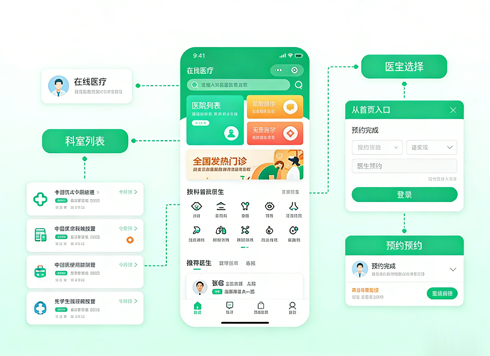
As one of the core functions of the mini-program, it needs to achieve the goals of "accurate matching, flexible appointment, and efficient reminder". During development, it is necessary to integrate the doctor scheduling system, support screening by department, disease type, and doctor title, and display the remaining number of registered slots in real time. Meanwhile, a "time-period appointment" function is provided, which accurately sets the registration time within 30 minutes, allowing patients to choose the consultation time period according to their own situation. Data shows that time-period appointments can increase the dispersion rate of hospital consultation peaks by 50%, and the average waiting time for patients is shortened from 90 minutes to less than 30 minutes.
In addition, SMS/WeChat reminders are set upon successful appointment, including consultation time, department location, precautions and other information; cancellation of appointments and transfer of registered slots (requiring real-name authentication) are supported to reduce the waste of registered slots. After a traditional Chinese medicine hospital launched this function, the utilization rate of registered slots increased by 28%, and the no-show rate dropped to below 5%.
2. Full-Process Navigation and Department Guidance
To address the problem of patients "finding it difficult to locate departments and examination rooms", indoor navigation functions of Amap or Baidu Maps are integrated to realize full-path guidance from "hospital gate - department - examination room - pharmacy". During development, it is necessary to collect hospital indoor map data, mark the location of each department, elevator entrances, toilets, payment windows and other key nodes, and support voice navigation and AR real-scene navigation. User research shows that for mini-programs equipped with intelligent navigation, patients' satisfaction with hospital services has increased by 42%, and the rate of consultation delays caused by inability to find departments has decreased by 60%.
3. Online Consultation and Inquiry Platform
To meet the needs of patients for "treating minor illnesses without leaving home and regular consultation for chronic diseases", three service modes are developed: text consultation, voice consultation, and video consultation. For common illnesses such as colds and coughs, a fast consultation channel is provided with a response time of no more than 5 minutes; for chronic disease patients, binding to exclusive doctors is supported to achieve long-term health management. Meanwhile, a drug consultation module is built, where pharmacists answer medication questions online to avoid medication risks. Data shows that online consultation via mini-programs can divert 30% of outpatient volume, increase the follow-up frequency of chronic disease patients by 25%, and reduce the medication error rate by 18%.
4. Query of Inspection Results and Reports
The hospital's Laboratory Information System (LIS) and Picture Archiving and Communication System (PACS) are connected to realize real-time synchronization of inspection results. When the results are available, users are pushed reminders in a timely manner, supporting online viewing, downloading and sharing of reports with family members. Under the traditional model, patients need to travel to and from the hospital an average of 1.2 times to collect reports; after the launch of the mini-program, this figure dropped to 0.1 times, saving patients over 90% of time costs.
5. Convenient Payment and Fee Details
Mainstream payment channels such as WeChat Pay and Alipay are integrated to support full-scenario payment of outpatient fees, inspection fees, drug fees, etc. After payment is completed, electronic bills are generated in real time, which can be directly downloaded for medical insurance reimbursement. Meanwhile, a fee detail query function is provided to clearly display the composition of various fees and avoid the problem of "ambiguous charges". Data from a hospital shows that the proportion of online payments via mini-programs reaches 78%, the number of people queuing at payment windows is reduced by 65%, and the average time spent by patients on payment is shortened from 15 minutes to 1 minute.
III. Value-Added Service Module: Extended Functions to Improve User Stickiness
In addition to core medical treatment functions, value-added services are provided to meet users' health management needs and improve the frequency of use and user stickiness of the mini-program.
1. Personalized Medical Information and Health Guidelines
Based on user data such as age, gender, and past medical history, accurate health information is pushed, for example, blood pressure management knowledge to hypertensive patients and prenatal care content to pregnant women. The information content must be reviewed by professional doctors to ensure scientificity and authority. Meanwhile, health tools such as BMI calculator, blood glucose record, and vaccination reminder are provided. Data shows that mini-programs with personalized information have 55% higher monthly active users (MAU) than ordinary mini-programs.
2. Hospital Evaluation and Feedback System
An anonymous evaluation function is set up, allowing users to rate and leave comments on doctors' service attitude, consultation environment, diagnosis and treatment effects, etc. The hospital receives feedback in real time and establishes a closed-loop mechanism of "feedback - processing - reply", with processing results synchronized to users within 3 working days. This function not only helps the hospital discover service problems in a timely manner but also enhances users' sense of participation. Through the mini-program feedback system, a hospital successfully resolved 82% of user complaints, and service satisfaction increased to 92%.
IV. Technical Support Module: Underlying Support for Safety and Stability
The sensitivity of medical data and the continuity of services put forward extremely high requirements for the technical architecture, which is the core guarantee for the stable operation of the mini-program.
1. Data Security and Privacy Protection
Strictly abide by laws such as the "Personal Information Protection Law" and the "Data Security Law", and adopt a triple protection system of "transmission encryption + storage encryption + access authorization". User data is encrypted with SSL technology during transmission, stored in a distributed database, and regular data backup and security audits are conducted. A data access log is established to give real-time warnings for abnormal access behaviors to ensure that data is not leaked or tampered with.
2. High Concurrency and System Stability
For scenarios such as peak registration periods, elastic scaling technology of cloud servers is adopted to ensure that the system can still run stably when the concurrency reaches 100,000+. During development, multiple rounds of pressure tests are conducted to simulate extreme traffic scenarios, optimize system response speed, and control page loading time within 2 seconds. Meanwhile, a fault emergency plan is established, and once a system problem occurs, the backup system can be activated within 5 minutes to ensure uninterrupted services.
3. Interface Design and User Experience Optimization
Following the design principles of "simplicity, ease of use, and efficiency", a clear navigation structure is adopted, with core functions such as registration, consultation, and report inquiry placed in prominent positions on the homepage. For elderly users, the interface font size and button spacing are optimized to reduce complex operations; for young users, personalized settings such as dark mode are added. Through user experience testing, the interface layout is continuously adjusted, reducing the operation difficulty of the mini-program by 60%, and the time for new users to get started is no more than 3 minutes.
V. Development and Operation: Full-Process Planning from Launch to Implementation
A high-quality hospital mini-program not only requires perfect function design but also scientific development processes and operational strategies.
In the development phase, it needs to go through five links: demand research, architecture design, prototype development, function development, and test optimization. Among them, the testing phase needs to cover multiple dimensions such as functional testing, performance testing, security testing, and user experience testing to ensure no obvious vulnerabilities before launch. Data from a project shows that mini-programs that have undergone multiple rounds of testing have a failure rate of less than 3% after launch.
In the operation phase, the mini-program is promoted through channels such as the hospital's official website, official WeChat account, and offline guidance desks, and user feedback is collected regularly to optimize functional modules. For example, according to user needs, new functions such as "physical examination appointment" and "vaccination inquiry" are added to improve the practicality of the mini-program.
Conclusion: Empowering Medical Care with Technology, Making Services More Warm
The development of hospital mini-programs is essentially using technology to break the temporal and spatial limitations of medical services and implement the concept of "patient-centered" in practice. From shortening waiting time to optimizing payment processes, from online consultation to health management, the design of each function should revolve around users' real needs.
Of course, different hospitals have differences in scale, department settings, and service focus, so the development of mini-programs also needs to be adapted to local conditions. The Xiyue team has been deeply engaged in medical system development for many years and can provide full-process services from demand analysis, architecture design to development and implementation, and operational support according to the specific needs of hospitals.
Follow Xiyue Company, and you will have an extra friend who understands system software development by your side. Let us together empower medical care with technology and make health services accessible at your fingertips.