




Solution for Developing a Nursing Home Visit Mini Program
Driven by the deepening aging population (the proportion of people aged 60 and above in China has exceeded 20%) and the hierarchical medical needs, the centralized service model of traditional medical institutions can no longer cover scenario-based demands such as home care and chronic disease management (CDM). Especially for groups with limited mobility such as the disabled and semi-disabled elderly and post-operative rehabilitants, the accessibility and convenience of medical services have become core pain points. The "Internet+Nursing" model, through the in-depth integration of digital technology and professional nursing services, has built an end-to-end service system covering "demand initiation - service matching - process control - effect tracing", and the home nursing mini-program serves as the core carrier of this system.
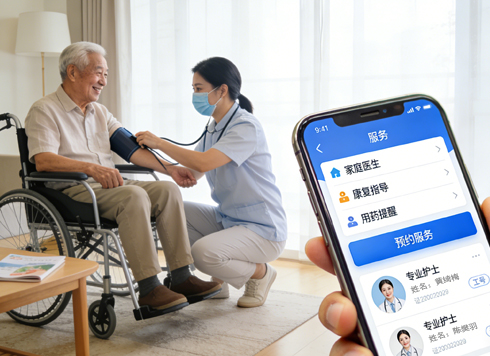
This paper systematically elaborates on the entire development process of the home nursing mini-program from five dimensions: demand deconstruction, technical architecture, functional design, implementation path, and development planning. It provides implementable technical solutions for relevant enterprises and developers, helping to build a safe, efficient, and inclusive home care service platform.
I. Demand System Analysis
1.1 Market Demand Positioning
The number of home-based elderly care recipients in China has exceeded 200 million, among which the disabled and semi-disabled elderly account for 19.4%. This group has rigid demands for professional services such as wound care, rehabilitation training, and chronic disease monitoring. Under the traditional model, such demands face three major bottlenecks: first, scattered service supply, with the coverage rate of home-based services by medical institutions less than 30%; second, inefficient resource matching, making it difficult for users to quickly connect with qualified nursing staff; third, lack of standardized management of service quality, resulting in low user trust.
At the same time, regular nursing needs of chronic disease patients (over 300 million confirmed cases in China), post-operative rehabilitants, and daily care needs of the disabled all suffer from "insufficient professionalism and delayed response". Based on this, the home nursing mini-program has become a key tool to resolve the supply-demand imbalance in home care by integrating high-quality nursing resources and establishing standardized service processes.
1.2 Target User Portraits
- Elderly Group: Aged 60 and above, with limited mobility, long-term bed rest, or needs for chronic disease management. They require regular access to basic medical and nursing services, and rely on their children for operational assistance or simplified interfaces.
- Chronic Disease Patients: Mainly patients with diabetes, hypertension, chronic obstructive pulmonary disease (COPD), etc. They need continuous nursing services such as daily/weekly blood glucose monitoring, medication guidance, and dietary intervention.
- Post-operative Rehabilitants: In the home rehabilitation period after surgical operations, they require targeted services from professionals such as wound dressing change, infection prevention and control, and rehabilitation training.
- Disabled Persons: Those with difficulties in daily living due to physical or intellectual disabilities, requiring long-term daily care and basic medical support. Their service needs are characterized by stability and personalization.
- User Relatives: As the main decision-makers and payers for services, they focus on service safety, professionalism, and process transparency, and need to obtain real-time feedback on service progress.
1.3 Core Competitive Advantages
- Precise Service Reach: Based on LBS (Location-Based Service) positioning technology, geographic matching between "users and nursing staff" is realized, with the average response time reduced to within 2 hours, solving the problems of "long distance and long waiting time" in traditional services.
- End-to-End Standardization: Establish a standardized system covering service reservation, staff dispatch, process recording, and evaluation filing. Each service link has clear operating specifications and quality standards.
- Dual Safety Guarantees: On one hand, build access barriers for nursing staff through qualification review, background checks, and pre-job training; on the other hand, introduce full-process service recording, emergency call, and insurance coverage mechanisms to reduce service risks.
- Data-Driven Optimization: Based on user health data and service feedback, dynamically adjust nursing plans to form a closed-loop management of "service - evaluation - optimization".
II. Technical Architecture and Selection
Combined with the mini-program's requirements for lightweight, high concurrency, and strong security, a technical solution of "lightweight front-end interaction + back-end microservice architecture + cloud-native deployment" is adopted to ensure system stability and scalability.
2.1 Front-End Technology Stack
- Development Framework: WeChat Mini Program native framework combined with Taro multi-end adaptation solution is adopted, taking into account WeChat ecosystem compatibility and future multi-platform expansion needs, supporting one-time development and multi-end operation.
- UI Component Library: Vant Weapp component library is introduced to build a concise interface in line with the usage habits of elderly users. Key operation buttons are enlarged by 30%, and voice interaction is supported to replace text input.
- Data Interaction: WebSocket is used to realize real-time push of service progress. HTTPS + AES encryption is adopted to ensure data transmission security, and sensitive information (such as ID numbers) is stored in desensitized form.
2.2 Back-End Technology Stack
- Development Language and Framework: Java + Spring Boot microservice framework is selected, splitting independent modules such as user service, order service, payment service, and medical staff management service to support on-demand scaling.
- Database Selection: MySQL 8.0 is used as the main database to store structured data (user information, order records, etc.); Redis is introduced to implement high-frequency data caching (such as online status of medical staff, popular service lists) to improve response speed.
- Server Deployment: Cluster deployment is built based on Alibaba Cloud ECS, using load balancing technology to distribute access pressure, and matching with RDS database service to achieve automatic data backup and disaster recovery.
2.3 Integration of Core Third-Party Services
- Payment and Settlement: Integrate WeChat Pay Merchant Platform, support payment associated with electronic medical insurance certificates, realize real-time splitting of self-payment and medical insurance reimbursement, and comply with medical payment regulations.
- Location Service: Access Amap API to realize functions such as accurate user address parsing, real-time trajectory tracking of medical staff, and intelligent delineation of service scope.
- Message Notification: Integrate Alibaba Cloud SMS Service and WeChat template messages to achieve full-process message delivery including reservation confirmation, service reminders, and evaluation notifications, with a delivery rate of over 99%.
- Identity Verification: Connect to public security system face recognition API and medical staff practice information inquiry platform to realize real-name verification and qualification verification of users and medical staff.
III. Core Functional Module Design
Functional modules are designed with "user experience as the core and service safety as the bottom line", covering the dual-end needs of users and medical staff, and realizing digital management of the entire service process.
3.1 Core Functions of User End
3.1.1 Account System and Identity Authentication
Supports two login modes: WeChat quick login and mobile phone verification code login. New user registration requires completing a three-step process of "basic information filling - real-name verification - emergency contact binding". Basic information includes core data such as name, age, and health status (past medical history, allergy history); real-name verification is completed by uploading ID card front and back photos or face recognition, and the system automatically verifies with public security interfaces; at least 2 relatives' information must be retained for emergency contacts to ensure timely communication in case of emergencies during services.
3.1.2 Service Reservation and Matching
Service classification adopts a four-level system: "Medical Nursing - Rehabilitation Guidance - Daily Care - Specialized Services", including:
- Basic Medical Nursing: Venous blood collection, wound dressing change, pressure ulcer care, blood glucose and blood pressure monitoring, oxygen therapy nursing, etc. The applicable scenarios and medical staff qualification requirements for each service are clearly marked.
- Rehabilitation Guidance Services: Post-operative joint mobility training, stroke rehabilitation intervention, chronic disease exercise guidance, etc., providing personalized rehabilitation plan generation function.
- Daily Care Services: Bathing assistance, meal assistance, mobility assistance, daily living care, etc. Service staff must hold elderly care worker qualifications.
- Specialized Services: Maternal and child care, palliative care, home accompanying consultation, etc., matching medical staff with corresponding specialized qualifications.
During the reservation process, users can independently select service time (accurate to 30 minutes) and service staff (view qualification certificates, service ratings, past cases). The system recommends the optimal candidate based on the principle of "distance priority + rating priority". After submitting the reservation, the medical staff will confirm the order within 15 minutes; if it times out, an alternate staff will be automatically matched.
3.1.3 Payment and Order Management
After order confirmation, two payment methods are supported: "full prepayment" or "deposit prepayment (20%)". The cost details include service fee, transportation fee, consumable fee, etc., which are clearly priced and synchronized to the electronic order. The platform regularly launches activities such as long-term service packages and new user exclusive offers, and users can redeem service discounts through points. The order management module supports functions such as viewing service progress (pending acceptance, pending service, in service, completed), downloading electronic invoices, and applying for service refunds. All order data is retained for more than 3 years, complying with medical record management regulations.
3.1.4 Health Management and Interaction
Users can establish personal health records, which automatically synchronize health data from each service (such as blood glucose change curves, blood pressure fluctuation records). Based on data trends, the system generates health reports and pushes intervention suggestions. The interaction module includes service evaluation (detailed into 3 dimensions: professional competence, service attitude, and environmental adaptability, supporting text + image evaluation), problem feedback (24-hour response mechanism), and health science popularization column (providing authoritative content by cooperative medical institutions), building an integrated health service ecosystem of "service - management - science popularization".
3.2 Core Functions of Medical Staff End
3.2.1 Qualification Entry and Authentication
To settle in, medical staff need to submit materials such as ID card, professional qualification certificate (nurse license/physician license, etc.), work experience certificate, and certificate of no criminal record. The platform adopts a dual verification mechanism of manual review + system verification, with a review cycle of no more than 3 working days. After passing the authentication, they must complete pre-job training (service specifications, emergency handling, privacy protection, etc.) and pass the assessment before undertaking orders. Qualification information is dynamically reviewed every six months to ensure the validity of service qualifications.
3.2.2 Order and Scheduling Management
Medical staff can set service areas, service time periods, and specialized service types, and the system intelligently generates personalized schedules. After accepting an order, they receive real-time order details (user health status, service address, special needs) and can navigate to the service location. During the service, they must upload service records in accordance with specifications (such as photos of nursing operations, health data records), submit a service summary after completion, and the order is closed after user confirmation. The system supports batch order acceptance and order transfer (subject to platform review) to help medical staff optimize work efficiency.
3.2.3 Career Development and Protection
The platform establishes a star rating system (1-5 stars) for medical staff, which is dynamically adjusted based on indicators such as service volume, user ratings, and complaint rates. High-star staff can obtain benefits such as priority order dispatch and service premium. At the same time, it provides online training courses (cooperating with continuing medical education institutions to obtain credits), case sharing sessions and other development resources to help improve professional capabilities. Unified professional liability insurance and accident insurance are purchased for medical staff to reduce risk losses during services.
3.3 Core Functions of Platform Management End
Including modules such as user management, medical staff management, order monitoring, service quality inspection, and data analysis. The management end can real-time monitor the service process and intervene in abnormal orders (such as overdue unaccepted orders, user complaints); regularly spot-check service records to ensure compliance with medical specifications; generate user demand reports, service supply heat maps, etc. through the data analysis module to provide data support for platform operation optimization.
IV. Development and Implementation Process
4.1 Demand Research and Planning Phase (1-2 Weeks)
Form a research team consisting of product managers, technical developers, medical experts, and target user representatives. Through user interviews (no less than 50 target users), competitive product analysis (comparison of functions of mainstream nursing platforms), and policy research (such as the "Pilot Work Plan for 'Internet+Nursing Services'"), output the "Requirements Specification Document" to clarify functional boundaries, technical indicators, and compliance requirements. Establish a project team and formulate development plans and milestone nodes.
4.2 Prototype Design and UI Development Phase (2-3 Weeks)
Based on the requirements document, use Axure to build high-fidelity prototypes and complete the interface process design of the user end, medical staff end, and management end. Organize medical staff and elderly users to conduct prototype usability testing, collect feedback, and optimize interface logic (such as simplifying operation steps and enlarging interactive elements). UI design follows the concise and professional style of the medical industry, with main colors of blue (representing trust) and green (representing health) to ensure visual comfort.
4.3 Front-End and Back-End Development Phase (6-8 Weeks)
The front-end team completes mini-program page development, interaction logic implementation, and third-party interface docking (payment, positioning, etc.); the back-end team builds the microservice architecture and implements core functions such as data storage, business logic processing, and permission management; the testing team simultaneously conducts unit testing and interface testing to ensure development quality. Hold weekly project meetings during the development process to synchronize progress and solve problems.
4.4 Testing and Optimization Phase (2-3 Weeks)
Carry out comprehensive testing, including functional testing (covering all core processes), performance testing (simulating 100,000-level user concurrency scenarios), security testing (penetration testing and data encryption verification), and compatibility testing (adapting to different WeChat versions and mobile phone models). Invite 100 real users (including elderly groups and medical staff) to conduct gray-scale testing, collect usage feedback, and conduct targeted optimization (such as solving operation lag and simplifying the login process).
4.5 Launch and Release Phase (1 Week)
Complete the medical category filing of the WeChat mini-program, submit audit materials (including "Medical Institution Practice License", "Internet Hospital Qualification", etc.), and ensure compliance with WeChat platform audit specifications. After passing the audit, launch gradually by region. Select 2-3 pilot cities for promotion in the first phase, real-time monitor the system operation status, and promptly handle initial launch issues.
4.6 Operation and Iteration Phase (Long-Term)
Establish a 7×24-hour operation and maintenance monitoring mechanism. Real-time monitor server load, interface response speed and other indicators through Alibaba Cloud Monitoring Platform, with a fault response time of no more than 15 minutes. Collect user feedback and operational data monthly to form a "Product Iteration Report", launch a version update every quarter, optimize existing functions, and expand new service scenarios (such as intelligent health monitoring equipment linkage).
V. Compliance and Risk Management
5.1 Compliance Guarantee
Strictly comply with laws and regulations such as the "Cybersecurity Law of the People's Republic of China" and the "Guidelines for Medical Data Security". User health data storage meets the Level 3 requirements of the Information Security Technology - Classified Protection of Cybersecurity (GB/T 22239-2019); sign service agreements and privacy confidentiality agreements with users and medical staff, clarify data usage boundaries, and prohibit unauthorized data sharing; file service prices with local medical insurance departments to ensure compliant charging; all service behaviors of medical staff comply with industry norms such as the "Regulations on the Practice of Nurses" to avoid medical disputes.
5.2 Risk Management Mechanisms
- Service Safety: Confirm user identity before service, enable full-process recording during service (with user authorization), equip emergency call buttons, and establish an emergency linkage mechanism with nearby medical institutions.
- Dispute Resolution: Establish an independent dispute mediation committee, introduce third-party medical dispute appraisal institutions, and realize "24-hour response and 7-day disposal" of disputes.
- Public Opinion Monitoring: Real-time track platform reputation through keyword monitoring tools, promptly discover and handle negative public opinion, and maintain the platform's brand image.
VI. Future Development Planning
6.1 Intelligent Upgrade
Introduce AI technology to achieve three major upgrades: first, an intelligent pre-consultation robot that recommends suitable service types based on user symptom descriptions; second, a health risk prediction model that predicts potential disease risks through long-term user health data and pushes intervention plans; third, an intelligent scheduling system that achieves optimal order matching through big data analysis, improving service efficiency by more than 30%.
6.2 Scenario Expansion
Extend from home care to multiple scenarios, including enterprise employee health services (on-site physical examinations, workplace first aid training), community elderly care services (cooperating with community health service centers to establish service stations), maternal and child care (connecting with maternal and child center resources), etc., building a comprehensive health service network.
6.3 Ecological Cooperation
Establish strategic cooperation with medical institutions, elderly care institutions, and insurance companies: connect electronic health records with hospitals to achieve two-way data sharing; cooperate with elderly care institutions to provide professional nursing outsourcing services; launch "nursing service + insurance protection" packages with insurance companies to reduce user service costs.
6.4 Data Value Mining
Based on the accumulated user health data and service data on the platform, form regional health demand reports to provide data support for the government to formulate elderly care service policies and medical institutions to optimize service supply, realizing a virtuous cycle of "service - data - decision-making".
VII. Summary
The development of the home nursing mini-program essentially reconstructs the home care service chain through digital technology, solving core problems such as supply-demand mismatch, low efficiency, and lack of safety in the traditional model. Through precise demand positioning, reasonable technical selection, improved functional design, and strict risk management, this solution builds a win-win service ecosystem for "users - medical staff - platform". It not only provides convenient and accessible professional nursing services for groups with limited mobility but also expands career development space for medical staff, and further promotes the sinking and optimal allocation of medical service resources.
In the future, with the continuous iteration of technology and the improvement of the ecosystem, the home nursing mini-program will gradually upgrade from "basic service supply" to "intelligent health management", becoming an important digital support tool for promoting the construction of Healthy China and addressing the challenges of population aging.