





Digital Custom Development Solution for Coatings Mini Program
I. Project Background & Construction Objectives
The coating industry is currently at a critical window for online transformation. When consumers purchase coatings, they have extremely high demands for authentic color rendering and space matching effects. However, graphic and text displays on traditional e-commerce platforms fail to deliver the real texture of painted walls, leading to high online decision-making costs and low conversion rates. Meanwhile, coatings are low-frequency durable goods; brands lose contact with consumers post-purchase, lacking continuous interaction and repurchase incentives. In addition, many coating enterprises operate multiple sub-brands or regional channels, each requiring an independent mini-program image and operation system, which results in high repeated development costs and decentralized management.
To address the above pain points, this project proposes a full customized mini-program solution with core construction objectives as follows:
-
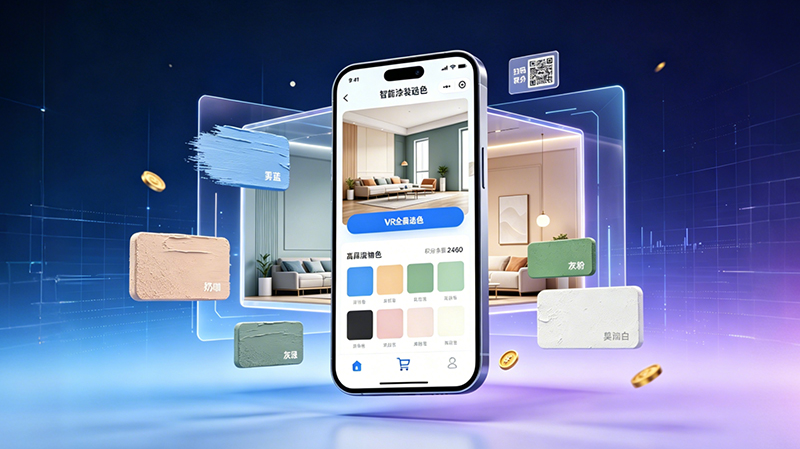
Develop immersive color selection tool: Adopt VR panoramic technology to build virtual home spaces. Users can freely switch color codes and preview painting effects in real time, significantly boosting online experience and purchase confidence.
-
Build a seamless transaction closed loop: Full online coverage of the entire process including product browsing, selection, order placement, payment and logistics tracking, supporting two fulfillment methods: express delivery and in-store pickup.
-
Establish long-term user operation mechanism: Link QR codes on product packages with a point system to complete anti-counterfeiting verification and point rewards in one step. Retain users continuously via point mall redemption and cash withdrawal functions.
-
Improve operation & management efficiency: Provide a one-stop admin backend for business teams to centrally handle daily tasks such as content updates, order processing and point rule adjustments, eliminating cross-system operations.
-
Meet independent operation demands for multiple brands: Support multiple brands within one system with separate mini-program interfaces, data spaces and function configurations, cutting capacity expansion costs while retaining brand individuality.
II. Overall Functional Architecture
The system consists of five horizontally layered modules with loose coupling and extensibility:
| Module | Core Sub-modules | Overview of Responsibilities |
|---|---|---|
| C-end WeChat Mini Program | Home Portal, Content Display, VR Effect Preview, Transaction & Ordering, Point Services, Personal Center | Full-function service portal for end consumers |
| B-end Operation Admin Backend | User Management, Content Management, Order Management, Point Operation, System Settings | Support daily management & configuration for operation teams |
| One Item One QR Code Material System | QR Code Library Mgmt (Generation/Export), Scan Data Statistics | Support product code assignment & scan behavior tracking |
| Multi-brand Adaptation System | Brand Tenant Mgmt, Theme & Function Configuration | Enable independent operation & differentiation for multiple brands |
| General Basic Support Layer | Permission Authentication, Security Risk Control, Data Dashboard | Unified technical foundation & security guarantee |
All modules interact via standard APIs with clear data flow. All business rules are configurable in the backend to minimize subsequent reconstruction costs.
III. Detailed Description of Core Functional Modules
3.1 C-end WeChat Mini Program (Consumer Side)
(1) Home Portal
As the brand’s online storefront, the homepage balances aesthetics and functionality. The top bar displays brand Logo and search entry; the middle section features quick accesses to core functions (e.g. "VR Color Selection", "Color Card Gallery", "Point Mall"); scrolling ad banners below are for campaign promotion; hot-selling products or cases are recommended at the bottom. All layouts and content cards can be dynamically adjusted in the backend. Operation staff can update content flexibly by season or promotion nodes without developer intervention.
(2) Content Display
This module covers three sub-modules: Color Card Library, Coating Case Library and Product Center:
-
Color Card Library: Multi-dimensional classification by color system, style (modern, Nordic, Chinese, etc.) and space (living room, bedroom, kids’ room). Each color card shows color code, color value, applicable scenarios, with an entry for VR effect preview.
-
Coating Cases: Upload HD images & videos of real renovation cases, mark corresponding coating color codes and product links. Users can jump directly to purchase identical products.
-
Product Center: Display product series list. Click to enter detail pages with specs, construction instructions, user reviews, linked VR scenes, and quantity selection for cart addition.
(3) VR Effect Preview (Core Highlight)
This module provides two immersive experience modes:
-
Panoramic Roaming: Users enter pre-set virtual show flats (living room, bedroom, etc.). Swipe fingers or rotate via gyroscope for 360° space viewing. Recommended color codes are listed on the sidebar; clicking any code switches wall colors in real time for direct comparison of overall atmosphere.
-
VR Video Playback: Play panoramic VR videos for dynamic coating processes or special textures (e.g. art paint). Users can view and learn product features simultaneously.
Each VR scene can bind one or multiple product SKUs with a "Buy Now" button on the interface, enabling seamless transition from experience to order placement and shortening decision paths effectively.
(4) Transaction & Ordering
The shopping cart supports consolidated settlement for multiple goods with automatic preferential calculation (full reduction, discount coupons). Users select delivery mode (express or in-store pickup), fill in delivery info and complete payment via WeChat Pay. After order generation, users can track status (Pending Payment, Pending Shipment, In Transit, Completed) in the personal center and apply for refunds or after-sales service.
(5) Point Services
Point services are the core tool for user operation:
-
Points via QR Scan: Built-in "Scan" entry in the mini-program. Scan QR codes on product packages; the system verifies code uniqueness. Pre-set points (e.g. 50 points per bottle) are issued automatically for first-time scans, alongside anti-counterfeiting results (Genuine / Suspicious).
-
Point Details: Users view point income, expenditure and current balance with timestamp & source notes for each record.
-
Point Redemption: The point mall displays redeemable goods (brand peripherals, paint samples, construction tools) or virtual benefits (free color matching service). Submit orders by deducting corresponding points.
-
Point Cash Withdrawal: Users may apply to convert points to cash and withdraw to WeChat Wallet once meeting the threshold (e.g. 1,000 accumulated points). Automatic transfer triggers after backend review approval.
(6) Personal Center
Aggregates frequently used user functions: avatar & nickname, point balance, pending order count, favorites, delivery address management, customer service chat entry, settings (privacy authorization, message subscription). The interface is concise for quick operations.
3.2 B-end Operation Admin Backend (Internal Management)
(1) User Management
Operators view a full list of registered users including WeChat nickname, registration time, point balance and account status (Normal / Frozen). Search by mobile number or nickname. User details display complete point change logs; manual point adjustment (for compensation/rewards) and account freeze/unfreeze are supported.
(2) Content Management
A unified content publishing center supports the following operations:
-
CRUD for color cards & cases, bulk import (Excel/image packages), tag assignment and sorting weight setup.
-
Product info editing: name, price, specs, inventory, main images, detail graphics & linked VR scene ID.
-
VR material upload: panoramic images (JPG/PNG) and panoramic videos (MP4). The system auto-generates preview links post-upload for binding with scenes & color codes.
-
Scheduled release for all content to pre-prepare campaign materials in advance.
(3) Order Management
Three order types are covered:
-
Product Orders: Display order ID, user, amount, payment status, logistics tracking number; support shipment marking, courier number entry and delivery slip printing.
-
Point Redemption Orders: Show redeemed goods, consumed points and delivery info; support shipment processing.
-
Withdrawal Applications: Display applicant, withdrawal amount, deducted points; support approval or rejection. Approved requests trigger automatic transfer via WeChat Corporate Payment API.
All order lists support filtering by time, status and type, with exportable reports for financial reconciliation.
(4) Point Operation
This module serves as the control center for the point system:
-
Rule Configuration: Set points per single scan, daily scan cap (anti-point farming), point validity period (year-end clearance or rolling validity).
-
Redemption Goods Mgmt: Maintain the redemption library (name, images, required points, stock quantity) with shelf on/off controls.
-
Withdrawal Parameters: Set minimum withdrawal point threshold, conversion ratio (e.g. 100 points = 1 RMB), daily withdrawal limit.
-
QR Code Generation: Generate unique encrypted QR codes by product batch & quantity with customizable prefix rules; export printable files embedded with anti-counterfeiting encryption data (PDF, AI, SVG).
(5) System Settings
Includes admin account management, role permission assignment (e.g. product admins only edit goods; order admins only process orders), operation logs (traceable records of all key admin actions), payment parameters (WeChat Merchant ID & secret key) and logistics freight template configuration.
3.3 One Item One QR Code Material System
This independent module serves production workflows:
-
QR Code Library Mgmt: Operators input batch name & generation quantity; the system auto-generates batches of globally unique encrypted QR codes to prevent counterfeiting. Multiple export formats (PDF, AI, SVG) compatible with various printing processes.
-
Data Statistics: Metrics by batch: total generated codes, scanned codes, first-scan time distribution, regional heatmaps. Evaluate market circulation speed and marketing performance of each batch to support subsequent production planning.
3.4 Multi-brand Independent Configuration System
Designed for enterprises with multiple sub-brands or regional branches. Multiple "brand sites" can be created within one backend, each with an independent mini-program AppID, isolated data storage (separate users, orders and points), exclusive theme settings (primary color, font, homepage layout) and toggleable functions (e.g. one brand may disable the point module while another shuts down VR). To add a new brand, fill in basic info and upload Logo & color schemes in the backend; the system auto-generates a preview mini-program for post-audit release. This mechanism eliminates repeated development while preserving independent operation autonomy for each brand.
3.5 General Basic Support Layer
-
Permission Authentication: The mini-program obtains unique user IDs via WeChat OAuth. Backend login requires account + password + graphic captcha, with secondary SMS verification optional. API access adopts Token authentication with granular permissions down to individual operation buttons.
-
Security Risk Control: Anti-point-farming & bot-order safeguards include frequency limits (hourly scan cap per user), abnormal IP interception and operation audit logs. All data transmission uses HTTPS encryption; sensitive data (user mobile numbers) is stored encrypted.
-
Data Dashboard: Aggregate core business KPIs: daily new users, page views, order revenue, point issuance/consumption volume, VR scene view counts, visualized via charts. Filterable by day/week/month for management to grasp overall operation status quickly.
IV. Core Business Workflows
4.1 Full Color Selection & Paint Purchase Workflow
User opens mini-program → Enters VR panoramic experience or browses color cards via home entry → Selects target color code and views linked product details → Picks specs & quantity to add to cart → Proceeds to settlement page, fills delivery address and selects delivery mode → Confirms order info and initiates WeChat Pay → Payment succeeds, order generated with push notification → Backend operators receive new orders and arrange shipment (or in-store stock preparation) → User tracks logistics info in personal center until order confirmation. For in-store pickup, the system generates a pickup code for offline verification at physical stores.
4.2 QR Scan for Points & Anti-counterfeiting Workflow
After purchasing physical coatings, user opens the mini-program "Scan" function to scan package QR codes → System validates code existence and first-scan status → Valid first scans return "Genuine" prompt and auto-issue points; scan device, timestamp and geographic location are logged simultaneously → User point balance updates in real time with push notification. If the QR code has been scanned before, a warning "This code has been used; contact customer service for inquiries" pops up to prevent duplicate point claims and serve as an anti-counterfeiting alert.
4.3 Point Consumption & Redemption Workflow
User enters the point mall to browse redeemable goods or withdrawal options → Submits application after target selection → System verifies sufficient point balance → For physical goods redemption: generate redemption order for backend review & shipment; For cash withdrawal: generate withdrawal application form for manual backend audit (threshold & anomaly checks) → Upon approval, deduct corresponding user points; physical goods proceed to shipment, withdrawal funds are transferred to WeChat Wallet via corporate payment → User receives success notification with viewable results.
Exception branches within above workflows (stock shortage, payment timeout, withdrawal retry failures, etc.) will be refined and configured during implementation to ensure complete closed-loop business logic.
V. Technical Implementation Scheme
This project adopts mature and stable tech stack to guarantee high system performance and maintainability:
-
Mini-program Side: Native WeChat development framework compatible with mainstream WeChat versions; reusable custom components; integrated panoramic playback plugin for VR interaction.
-
Admin Backend: Vue 3 + Element Plus, responsive design for PC access with user-friendly UI.
-
Backend Service: Spring Boot framework for RESTful APIs with layered architecture (Controller-Service-DAO). Redis cache accelerates interface response for hot data and session management.
-
Database: MySQL stores business data (users, orders, points, content) with index optimization for data tables; Redis for distributed locks and temporary caching.
-
File Storage: All images, panoramic VR images and videos are uploaded to object storage with CDN global acceleration for smooth VR asset loading.
-
Security Protection: Unified API signature verification, IP black/white list configuration, auxiliary anti-fraud risk control components from Alibaba Cloud or Tencent Cloud.
-
Deployment & O&M: Containerized deployment on cloud servers; auto-backup cloud RDS databases; persistent object storage; real-time monitoring with fault alerting.
The system supports horizontal scaling; service capacity can be expanded smoothly by adding instances during business growth without disrupting existing services.
VI. Implementation Principles & Collaboration Mode
The following implementation strategies are adopted to guarantee smooth project delivery:
-
Phased Delivery: Deliver core functions first (mini-program browsing, VR experience, order payment, QR scan points), followed by full admin backend and data statistics. Joint testing & acceptance are conducted for each phase.
-
Iterative Optimization: Collect user feedback post-launch, prioritize optimization for high-frequency scenarios, release minor version updates biweekly.
-
Configurable Business Rules: All rules covering points, freight and discounts are adjustable via backend parameters; business teams may modify settings independently without developer support.
-
Knowledge Transfer: Provide detailed operation manuals, API docs and O&M guides throughout the project; deliver multiple rounds of training for client admins to support independent daily content updates and basic troubleshooting post-launch.
VII. O&M Services & Supporting Resources
After formal project acceptance, we provide comprehensive 3-year O&M coverage including:
-
System Stability: 7×24 monitoring of server status and service availability. P1 incidents (full system outage) trigger response & remediation within 30 mins; monthly system health reports are provided.
-
Operation Support: Unlimited remote operation guidance, new staff training and emergency content update assistance (e.g. bulk product & VR material uploads for large promotions).
-
Minor Function Optimization: Free reasonable improvement requests (field adjustment, new statistical reports, UI tweaks) with workload below 3 man-days per request, capped at 30 man-days per year. Additional workloads are negotiated separately.
Project fees cover all third-party services required for operation over the next three years:
-
Cloud computing resources (cloud servers, cloud RDS, object storage, CDN traffic including bandwidth for VR video distribution).
-
Domain registration, filing maintenance and SSL certificate renewal.
-
User behavior tracking & analytics tool account.
-
Business risk control engine (anti-fraud & anti-scraping) license fees.
-
SMS verification code quota, base-rate WeChat Pay transaction fees.
Enterprises are exempt from extra procurement of basic infrastructure resources and may focus solely on business operation.
VIII. Expected Value & Conclusion
Implementation of this solution delivers the following values for coating brands:
-
Elevated consumer experience: Immersive VR color selection breaks physical store limits, lifting online conversion rates and average order value.
-
User asset accumulation: QR scan point mechanisms turn every product into a user connection touchpoint, building a sustainable private domain member pool.
-
Multiplied operation efficiency: Unified backend manages all content and orders, cutting costs from cross-system switching and manual financial reconciliation.
-
Flexible brand expansion: Multi-brand independent configuration enables fast rollout of new brands without repeated system construction.
-
Data-driven decision-making: Comprehensive dashboards provide multi-dimensional insights into user behavior, sales trends and point circulation to support marketing strategy formulation.
Rooted in real coating industry scenarios, this solution adopts a mature technical roadmap paired with complete service guarantees. It aims to deliver a long-term evolvable, self-controlled digital marketing service platform under controllable investment. We look forward to in-depth communication to jointly define a final implementation scheme aligned with your actual business demands.