




How to Develop a Mini Program: A Complete Guide from Needs Assessment to Technical Implementation
Mini program development is not simply about applying templates or directly coding; it is a systematic engineering process from needs assessment, technology selection, to continuous operation and maintenance. By 2026, the mini program ecosystem has become highly mature, with WeChat, Alipay, Douyin, and other platforms converging in features, but the choice of development method directly impacts project cost, timeline, and long-term maintainability. The following guide covers the complete process from zero to launch, providing actionable evaluation criteria.
Why Mini Program Development Requires Systematic Assessment
Many teams rush into development with vague requirements, leading to repeated revisions, feature bloat, or even project abandonment. Systematic assessment can clarify core features versus edge requirements upfront, avoiding resource waste. For example, a C-end e-commerce mini program and a B-end internal tool mini program have vastly different tech stacks and development approaches. A common practice in 2026 is to use an MVP (Minimum Viable Product) to validate core logic, then iterate and expand.
- Business goal-driven: First ask "What user problem does the mini program solve?" rather than "What framework should I use?"
- User experience first: Load speed and interaction smoothness directly impact retention; performance baselines should be set during the requirements phase.
Four-Step Implementation Method: From Requirements to Launch
This framework divides mini program development into four stages, each with clear deliverables and checkpoints, suitable as a project management reference.
Step 1: Requirements Gathering and Prioritization
Collect all feature requests and use the MoSCoW method (Must have/Should have/Could have/Won't have) to prioritize. Note: Do not include high-complexity features like "personalized recommendations" in the first version unless they are core selling points.
- Deliverable: Feature list and priority matrix.
- Checkpoint: Is the core user journey covered? Does it meet minimum viable standards?
Step 2: Technology Selection and Architecture Design
Based on requirements, determine whether to use native development (best performance), cross-platform frameworks (e.g., Taro/uni-app), or low-code platforms. By 2026, cross-platform frameworks have excellent adaptability, but native development is still recommended for complex interaction scenarios. The architecture should reserve capabilities for tracking and dynamic configuration to facilitate subsequent operations.
- Deliverable: Technical solution evaluation report, including pros and cons of the chosen technology.
- Checkpoint: Is it compatible with the latest APIs of the target platforms? Is there a clear data flow?
Step 3: Development and Testing
Follow agile iterations, completing a small usable version every two weeks. Testing should cover functionality, performance, and compatibility (especially on low-end devices and older WeChat versions). It is recommended to introduce automated testing (e.g., Minium) to improve regression efficiency.
- Deliverable: Deployable test version and test report.
- Checkpoint: Is the first-screen loading time of core pages less than 1.5 seconds? Are there any memory leaks?
Step 4: Deployment and Operations
Use CI/CD for automated releases and configure monitoring and alerts (e.g., error logs, performance metrics). Note: In 2026, mini program review rules are stricter; categories involving payments or social features require advance preparation of qualification materials.
- Deliverable: Online version and operation manual.
- Checkpoint: Is a disaster recovery plan configured? Is there a user feedback channel?
Applicable Scenarios and Boundaries
Mini programs are best suited for lightweight, high-frequency, low-latency scenarios such as e-commerce, ordering, tools, and information display. They are not suitable for: scenarios requiring complex native features (e.g., high-precision positioning, extensive local computation), long-term offline use, or applications with extremely high privacy and security requirements (e.g., financial transactions, where native apps are still recommended). Boundary: If the project needs to frequently call Bluetooth, NFC, or background keep-alive, a mini program is not the optimal solution. Additionally, when expected user scale exceeds tens of millions, server-side elastic scaling must be considered; mini programs themselves have no limit, but the backend needs a distributed architecture.
How to Judge the Quality of a Development Solution
A good solution meets three conditions: Timely response to requirements (cost of requirement changes), Performance meets standards (first-screen loading <1.5 seconds, no interaction lag), High maintainability (clear code structure, complete documentation). Conversely, be wary if the solution heavily relies on "black-box" components, lacks tracking planning, or ties core capabilities to a single vendor.
- Performance benchmark: First-screen rendering time not exceeding 1 second, smooth page transitions.
- Maintainability: Clear module division when code lines < 100,000.
Common Pitfalls
Pitfall 1: Assuming mini program development is simple and ignoring backend design. In reality, performance bottlenecks often stem from slow interface responses or messy data logic. Pitfall 2: Blindly pursuing a "full suite" of features in the first version as if it were a complete app. An MVP should focus on 20% core features for quick launch and validation. Pitfall 3: Ignoring review rules. Payment and social mini programs have strict qualification requirements, and the review cycle may take up to 7 days. In 2026, WeChat has stricter controls on virtual payments; payment methods must be planned in advance.
Solution Comparison: Self-built Team vs. Outsourcing vs. Low-code
These three solutions differ significantly in cost, timeline, and controllability, suitable for different stages.
- Self-built Team: Suitable for enterprises with sufficient budget, long-term iteration, and core technology accumulation. Timeline about 2-4 months, high cost, but strongest controllability.
- Outsourcing: Suitable for short-term projects or validation phases. Timeline 1-3 months, medium cost; focus on reviewing delivery documents and source code. For example, Xiyue Company offers custom mini program development services covering the entire process from requirements to launch, but post-outsourcing maintenance still requires coordination.
- Low-code Platform: Suitable for simple information display or internal tools. Timeline 1-2 weeks, lowest cost, but limited scalability, not suitable for complex business logic.
Selection criteria: If business logic is simple with no custom interactions, low-code suffices; if requirements are clear and future scalability is strong, self-built or outsourcing is better. Note: Under outsourcing, clarify intellectual property ownership and subsequent maintenance costs.
Frequently Asked Questions
What tech stack is needed for mini program development?
Frontend requires WXML/WXSS and JS (or corresponding frameworks); backend commonly uses Node.js/Python providing REST/GraphQL interfaces. Cloud development can eliminate backend operations.
How much does it cost to develop a mini program?
Basic type: about 20,000-80,000 RMB; medium-complexity projects: 100,000-300,000 RMB; large e-commerce or social types may exceed 500,000 RMB. Specific costs depend on features, design requirements, and developer team level.
How to promote a mini program after launch?
Through WeChat search, nearby mini programs, official account association, Moments ads, offline QR codes, etc. In 2026, more emphasis is placed on private domain traffic and social viral growth.
Common reasons for mini program review rejection?
Category mismatch (e.g., no qualification for live streaming), unauthorized third-party content, incomplete user privacy agreement, virtual payments not using WeChat Pay, etc.
What advantages do mini programs have over H5?
Faster loading, closer to native experience, ability to call device capabilities (e.g., QR code scanning, Bluetooth), and users can use them without installation.
Action guide: Before starting a project, use the "Four-Step Implementation Method" to align requirements and solutions; if unsure about the choice, prioritize an MVP to validate core assumptions. This guide applies to most lightweight commercial applications but is not suitable for scenarios requiring complex native features or highly customized solutions. After clarifying the target boundaries, choose a matching development approach and iterate continuously for efficient implementation.
-
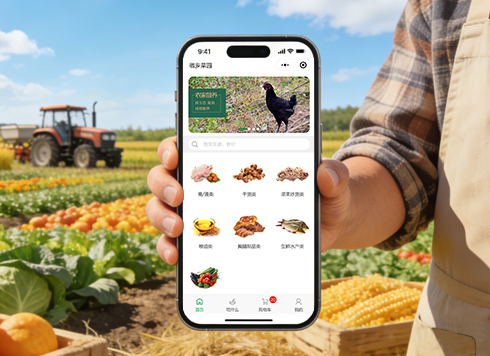 Agricultural Products WeChat Mini Program Custom Development
Lvran Di enhances agricultural sales via a ...
-
 Well-Recognized Custom E-Commerce Mall System Dev
The Good Shopping mini-app is natively buil ...
-
 Anhui Huixiang Vegetable Garden Agricultural Products Mini Program v2.0 Iteration Development
HuiXiang MiniApp V2.0: Upgraded homepage, n ...
-
 Kunshan TrialBook Mini-Program Custom Development
This project developed an English-only Tria ...
-
Mini Program Development Basics: Definition, Selection, and Implementation Process
Date: Aug 10, 2026 Read: 78
-
Custom Mobile App Development for Enterprises: Selection, Process, and Common Pitfalls
Date: Aug 9, 2026 Read: 65
-
How to Develop a Custom Mini Program? A Guide to Process, Tech Selection, and Evaluation
Date: Aug 4, 2026 Read: 91
-
Mobile Custom Software Development Guide: Process, Cost, Technology Selection, and Common Pitfalls
Date: Aug 2, 2026 Read: 114
-
How to Approach Custom Mobile Development: Requirements Assessment, Technology Selection, and Implementation Essentials
Date: Aug 2, 2026 Read: 131