





Custom website development: if the homepage is a single-scroll page, can a product center and news section still be added later?
Whether a single-scroll page can work depends first on two things: whether the content can be told through one main narrative, and whether visitors can complete the target action on the same page; then look one layer ahead — whether sections will need to be added later. Based on common 2026 delivery experience, scenarios with a single goal — a single product booking, an event landing page, a portfolio, or a recruiting feature — are fast to launch and easy to maintain as single-page sites; for a company website with many product models, long-term news publishing, and data viewed separately by channel, forcing everything into one page will usually require a small redesign later to clean up. Listing the content first and then deciding the structure usually saves more rework than choosing the visual style first.
Single-page sites and multi-page sites differ by more than page count
A single-page site puts content into one HTML page and presents it through scroll sections or anchor jumps; a multi-page site gives each topic its own URL. The surface difference is the number of pages, but the real difference is information architecture and the number of separately referenceable addresses: on a multi-page site, each address can have its own title, description, and share image, and can be indexed and measured separately; a single-page site usually has only one main URL, and anchors such as #product and #contact are generally not treated as independent landing pages.
There is also a hybrid approach: make the homepage a long page for brand storytelling, and open separate inner pages for products, cases, and news. Based on 2026 project delivery habits, the share of mid-to-large company websites using this structure is rising, because it balances first-screen visual impact and search entry points, while leaving room for later expansion.
- Pure single-page: one main URL plus several anchors; anchors are usually not independent landing pages.
- Pure multi-page: each section and each product has its own URL, with title, description, and share image configured separately.
- Hybrid: the homepage uses long-page narrative, while inner pages carry search traffic and content updates.
Why clients often ask for a single-scroll page
There are usually three motivations: they think it scrolls smoothly on mobile, they have seen some brand websites and think it feels premium, and they believe communication and delivery will be simpler. These ideas are not wrong in themselves, but first separate aesthetic preference from business need — aesthetics can be adjusted, while changing the information architecture costs much more.
A common misjudgment is equating “navigation without page jumps” with “only one page.” Technically these are two different things: navigation can be implemented with anchor scrolling, and it can also be a single-page application; but whether content should be split by topic depends on how many types of visitor intent you need to catch.
- Treating “looks premium” as a reason for having little content: a long page can actually cover a lot.
- Treating “less hassle” as simple structure: changing one part of a single page often affects the layout of the whole page.
- Ignoring visitor sources: visitors from different channels care about different things, and one page is hard to catch them all at the same time.
Four self-check questions: should this be a single page or multiple pages?
These four questions correspond to four layers — content, goal, search, and iteration — and are a lower-cost order of judgment summarized from projects. The first three determine the structure; the fourth leaves room for expansion — if any layer does not hold, a single page will become a burden within six months.
- Can the content be told through one main narrative? If parallel modules exceed 8 to 10 (experience range), the scroll length will make it hard for people to find the focus.
- Is there only one target action for visitors? Booking, lead capture, and viewing work can fit; if visitors also need to order, check specifications, and find after-sales service, it should be split into pages.
- Do you expect organic search to bring traffic? A single page has only one URL, so the number of topics and keywords it can carry is limited.
- Will content keep being added over the next year? If you need to publish news, launch new products, and update cases, a single page will become increasingly awkward.
Delivery scene: delivered as a single page first — what if sections need to be added six months later?
We have encountered this kind of project more than once, with broadly similar constraints: limited budget, only one or two screens of material ready, and the client clearly saying they want to launch one page first to see the effect. The approach at the time was still to deliver as a single page, but reserve data structures by section in the backend, reserve secondary positions in the navigation, and record analytics under the main URL with a unified standard. The result was a fast launch and a first screen that could be presented; the cost was that when the client wanted to add a product center and news section six months later, the layout, navigation, and backend still needed to be rearranged. The workload typically falls in the range of a small redesign, and the cost mostly falls between 10% and 30% of the original contract amount (experience range, depending on the number of new pages and the amount of backend rework). If it had been built as a hybrid from the start, most of this rework could have been avoided, at the cost of one to two extra weeks for the first version.
Anchor navigation on mobile is also prone to two problems: a sticky navigation bar covering headings, and scroll positioning being interrupted by animations. Before delivery, clicking through section by section on a real device is more reliable than resizing the window on a computer.
Single-page vs. multi-page sites: a comparison across several dimensions
This set reflects commonly used judgment criteria in projects; the numbers are all experience ranges, and actual results are affected by design complexity, material completeness, and the number of features, so they should not be used directly as a quote.
- Delivery timeline: single-page sites commonly take 2 to 4 weeks; show-type multi-page sites with the same content volume commonly take 4 to 8 weeks.
- Cost: at the same content volume, a single-page site usually costs 20% to 40% less than a multi-page site (experience range).
- Search entry points: multi-page sites can cover more keywords and different visitor intents; single-page sites concentrate on a few core terms.
- Analytics: anchor clicks on a single page are harder to count as independent views, so the measurement standard should be explained before looking at data.
- Later maintenance: changes to a single page affect the whole site; with multiple pages, you can change just one page, with less spillover.
- Best fit: single-page sites suit a single product, booking, or portfolio; multi-page sites suit multiple categories and teams with a content operation plan.
When it fits, and when not to force it
Cases that fit a single page: only one or two products, a single target action for visitors, low content update frequency, or just one event, one recruiting feature, or one portfolio display. In these scenarios, a single page is quick to launch and simple to maintain, and visitors are less likely to get lost just because they scroll for a long time.
The cases that do not fit are equally clear: if you need to publish news continuously, have many product models with large specification differences, need to view data separately by channel or region, or plan to add multiple languages, do not force it into one page. The boundary can be remembered in one sentence — if it can be told through one narrative line, use a single page; if it needs to display multiple choices side by side, use multiple pages.
- For paid landing pages, it is advisable to use one URL per channel; mixing them on the same page makes it hard to tell which channel is effective.
- If you really want to keep the single-page feel, you can make the homepage a long narrative and put products and cases on inner pages to carry them.
FAQ
Does a single-page site affect search engine indexing?
There are limits. A single page has only one main URL, anchors are generally not indexed as independent pages, and the number of keywords it can cover is limited; if it is only for brand display, the impact is usually small.
If I want to add a product list after a single-page site goes live, is it expensive to change?
It is more expensive than splitting pages from the start. The layout, navigation, and backend structure all need to be rearranged; it is commonly assessed as a small redesign in workload, and the cost range is mostly 10% to 30% of the original contract amount.
If a single-page site feels janky when scrolling on mobile, what is usually wrong?
It is often related to first-screen image size, the number of scroll animations, and the number of modules rendered at once. Compressing assets first and delaying the loading of non-first-screen modules can ease most cases.
For advertising, is a single-page site enough?
It can be enough, but it is advisable to use one landing page URL per channel; otherwise, data from different channels is mixed on the same page, making it harder to judge campaign performance.
If you are only showcasing one product or one event, a single-page site can be delivered in an experience range of 2 to 4 weeks, and maintenance is simpler; but if you expect to launch new products, publish news, or add multiple languages within a year, it is advisable to build it as a multi-page site from the information architecture stage, while the homepage can still keep the narrative feel of a long page. When unsure, first list the content you plan to include: what can be merged into one main narrative can go on a single page; what cannot be merged should not be forced.
-
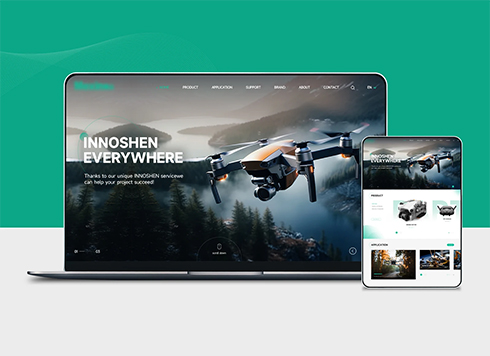 Drone Accessories Company Website Development
Incorporating gray as an accent with the pr ...
-
 Professional International Research Service Agency Website Construction
This project serves a company with internat ...
-
 The Construction of Group Websites for Asset Operation and Digital Services
This project is to create a website for a c ...
-
 Thermal Test Equipment Website Construction
Founded in 2022, this tech company focuses ...
-
All services crammed onto one long page: will AI drag in the others when a client asks about one?
Date: Sep 23, 2026 Read: 27
-
Custom website development: the client compares Baidu Analytics and GA for the monthly report and the numbers differ by 2x — which set should be used?
Date: Sep 27, 2026 Read: 16
-
Custom Website Development: After a Small Site Adds a CDN, the Client Says Backend Content Changes Do Not Update—Was the Money Spent in the Wrong Place?
Date: Sep 26, 2026 Read: 21
-
Custom website development: client saw content summarized by AI and insists on blocking all crawlers in robots.txt—will search indexing be blocked too?
Date: Sep 25, 2026 Read: 24
-
Custom website development: everything works on the test site, but it breaks as soon as the production domain goes live — is it an environment mismatch?
Date: Sep 24, 2026 Read: 26