Which renewal item—domain, hosting, or email—will make a Shanghai company website go down if missed?
Quotable conclusion: The annual renewal for a Shanghai company website is usually not a single payment, but domain, cloud hosting or virtual space, SSL certificate, business email, CDN acceleration, and the maintenance package from the website builder or SaaS platform. Based on common 2026 delivery experience, these items together typically fall within the experience range of several hundred to several thousand RMB per year. Among them, the consequences of missing a domain or hosting renewal deserve relatively more attention: at best the website goes down; at worst the domain enters the redemption period or is registered by someone else. So renewal is not just "paying the bill and being done"—it means managing the expiry date and responsible person for each item.
Which items does a Shanghai company website renew every year?
Many people think "renewal" is a single payment to the website builder, but in reality it is several independent bills. In Shanghai, a company website is often coordinated by the marketing department, paid by the IT department, and maintained by an outsourcing vendor—three lines each handling a different part, which easily creates gaps where everyone assumes someone else is managing it. Only by breaking the items down first can you judge which must be kept and which can be stopped.
- Domain: Renewed annually per registrar rules, commonly tens to just over one hundred RMB per year. It is one of the few items that, if expired, may be registered by someone else.
- Cloud hosting / virtual space: Commonly several hundred to several thousand RMB per year. Once expired, the website goes down directly.
- SSL certificate: Free types can cost nothing; paid types commonly cost several hundred RMB per year. After expiry, browsers will show a "not secure" warning.
- Business email: Billed per account, commonly tens to several hundred RMB per account per year. If stopped, you will not receive inquiry emails.
- CDN / acceleration service: Usually billed by usage, commonly several hundred to several thousand RMB per year. Stopping it generally only slows things down, not take the site offline.
- Maintenance package or SaaS platform annual fee: Commonly several thousand to tens of thousands RMB per year, depending on whether it includes redesigns, backups, and technical support.
One point easily overlooked: ICP filing itself is free, but it depends on the domain and the hosting provider. If the domain expires, the server is stopped, or the hosting provider is changed, the filing may enter an abnormal state. So the filing should be viewed together with the items above, not as a separate certificate.
Why is website renewal more easily missed in Shanghai?
A common situation in projects: the company's marketing lead has changed, the domain was registered with a former colleague's email, and renewal reminders go to that deactivated account. IT thinks the outsourcing vendor is managing it; the vendor assumes the marketing department is on it. As a result, the website goes down on the expiry day, right when a trade show invitation or bid registration deadline hits. The constraints are often "no separate budget line and only a few days left to act." The usual approach is to urgently renew to restore the site, then create an expiry ledger; the cost may be extra redemption fees, or temporarily using a third-party page for a few days and having to change links and materials back later.
Two local factors in Shanghai further amplify this. First, when the headquarters or group centrally procures cloud resources, the website account is under the group's name, so the subsidiary's marketing department can neither see the expiry date nor has renewal permission. Second, in foreign-invested, joint-venture, or multi-entity companies, the domain, server, and filing may belong to different company entities, so a personnel handover easily breaks the chain. Based on common 2026 practice, at least two current employees should be able to log in to and receive notifications for website-related accounts—this is more practical than any reminder software.
How do you judge which items must be renewed and which can be stopped?
The criterion is not "expensive or not," but "what happens to the business if it is stopped." You can do an audit in the following four steps; this is also a commonly used ledger method in local delivery.
- Step 1: Make a list: Write down domain, hosting, SSL, email, CDN, maintenance package, and platform annual fee item by item—do not rely on memory.
- Step 2: Mark the impact: For each item, ask "what happens if it stops?"—site down, insecure warning, no email received, or just slower.
- Step 3: Assign responsibility and dates: Write clearly who is responsible, the next expiry date, and who currently holds the login account.
- Step 4: Leave a buffer: Set reminders 30 to 60 days in advance, or enable auto-renewal, and confirm the payment method is still valid.
The reason for this division: impact determines priority, while responsibility and dates determine whether someone will actually act. It passes if "for every item you can state the consequence of stopping it and name a current responsible person." A counterexample is a list with only one line: "Website annual fee, pay at year-end"—once the handler leaves, that information is as good as nonexistent.
Self-management or hand it to the website builder? Comparing the two approaches
Both approaches can work; the difference lies in who bears the responsibility for "remembering" and "getting it done." Based on project delivery experience, you can compare them across the following dimensions:
- Suitable for: Companies with IT or dedicated operations staff are better suited to self-management; those with a small marketing team and an outsourced website are more at ease with managed service.
- Cost: Self-management has lower direct spending but requires labor time; managed service is usually bundled into maintenance services, with a typical range of several thousand to tens of thousands RMB per year, depending on the scope.
- Risk points: Self-management risks losing contact with the account after personnel changes; managed service risks the domain and hosting being under the service provider's name, making handover difficult when the company wants to change providers.
- Response speed: With self-management, you troubleshoot yourself; with managed service, response is faster during service hours, and usually waits until the next business day outside service hours.
- Criteria for judging good or bad: No matter who manages it, you must be able to obtain renewal receipts, log in to the backend yourself, and transfer the domain and server away when the cooperation ends. If these three cannot be done, the peace of mind from managed service is borrowed.
For websites using managed service, the provider usually writes clearly in the contract the ownership of the domain and hosting, how renewal receipts are provided, and the transfer-out process after the cooperation ends—so that years later both parties are not unclear about who originally bought what. Such agreements are not complicated, but writing them earlier is better than later.
A few easily overlooked pitfalls
These are not theoretical issues; they have appeared repeatedly in local projects. Avoiding them in advance can save a lot of trouble.
- Auto-renewal does not guarantee success: An expired payment card, insufficient balance, or a notification email belonging to a departed employee can all cause the charge to fail silently.
- Domain and hosting expire in the same month: If forgotten, the website goes down at the same time, making troubleshooting longer. If conditions allow, stagger them to different months.
- Leaving only one person's contact information: Common practice is to leave email and mobile numbers for at least two current employees and ensure they can log in to the backend.
- The package price does not specify what is renewed: When signing the contract, ask clearly which items the managed scope includes and which require extra payment, to avoid bill changes in the second year.
- Treating the filing as permanently valid: Changes in access information or long-term inaccessibility of the website may trigger verification, and you need to cooperate according to the hosting provider's requirements.
Applicable scenarios and boundaries
If the website plays a role in lead generation, bidding, qualification display, or customer due diligence, then basic items such as domain, hosting, and email are parts that need continuous maintenance. It is recommended to fix them using the four-step list above, review once a year, so that anyone taking over can understand it.
The boundaries should also be clear: if it is only a short-term campaign page or temporary promotional page that will not be used after a few months, there is no need to equip it with filing, email, and long-term maintenance at the specification of a corporate website. Using a third-party platform page and stopping at expiry is actually more convenient. Similarly, if the company already has a group-wide unified domain and IT management process, the subsidiary's marketing department does not need to set up a separate one; following the group is more reliable, but you must confirm that you are indeed on that notification list.
FAQ
Can an expired domain be redeemed immediately?
There is usually a grace period of several tens of days, after which it enters the redemption period. The cost is significantly higher than normal renewal. Specific rules depend on the registrar; the earlier you contact the registrar, the better.
If I forget to pay for website space renewal, will the data inside be lost?
Most service providers keep it for a period before clearing it; the specific duration depends on the provider's rules. After discovering the expiry, do not reinstall first—contact the provider to confirm the retention status and back up as soon as possible.
Can the filing be cancelled because the domain expires?
It is possible. Long-term inaccessibility of the website or changes in access information may trigger verification by the hosting provider. If not handled promptly, it may affect the filing status; specific requirements depend on the hosting provider.
If auto-renewal is enabled, does that mean I do not need to manage it?
Not necessarily. An invalid payment method, insufficient balance, or a deactivated reminder email can all cause the charge to fail. It is recommended to manually check the expiry date and payment method at least once a year.
If I use a local Shanghai website builder for managed renewal, what should I confirm?
Confirm who the registrant entity is for the domain and hosting accounts, whether renewal receipts can be provided, and whether a smooth transfer-out is possible after the cooperation ends. These three points are best written into the contract.
If the website is still in use, it is recommended to make a table this week listing the expiry dates and account owners for domain, hosting, SSL, and email, set reminders 30 to 60 days in advance, and write the managed scope into the contract. Conversely, if it is only a temporary page with no filing and no long-term lead-generation needs, there is no need to maintain it at the specification of a corporate website; stopping it as needed saves more cost. You can verify against the expiry rules of your domain registrar and cloud service provider.
-
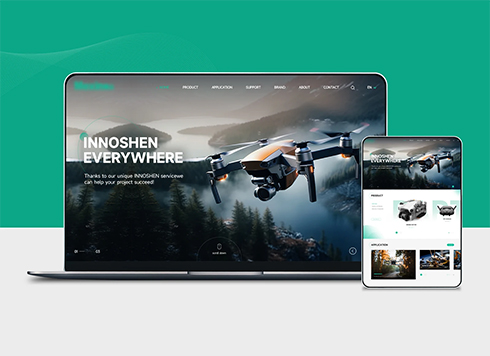 Drone Accessories Company Website Development
Incorporating gray as an accent with the pr ...
-
 Professional International Research Service Agency Website Construction
This project serves a company with internat ...
-
 The Construction of Group Websites for Asset Operation and Digital Services
This project is to create a website for a c ...
-
 Thermal Test Equipment Website Construction
Founded in 2022, this tech company focuses ...
-
Beijing company website with ICP filing still under the boss's personal name: will ad campaigns get blocked later?
Date: Sep 17, 2026 Read: 10
-
Fuzhou company website: I send the same link and it shows a thumbnail, but when a client forwards it only a URL line remains — what is causing this?
Date: Sep 16, 2026 Read: 12
-
Xi'an company website: Why does Baidu show a recruiting page first when customers search the company name?
Date: Sep 15, 2026 Read: 14
-
Hefei business website: if customers mostly view it on mobile, is a simplified PC version enough?
Date: Sep 14, 2026 Read: 27
-
Jinan company website is done, but the official website link in Baidu Maps won’t open—is it a map update issue or a website problem?
Date: Sep 13, 2026 Read: 24