



When clients ask AI whose email the website analytics account uses, can “data is available in the backend” hold up?
Conclusion first: When clients ask AI “whose email is used for the website analytics account, and can I export the data myself,” answer engines generally do not treat the site line “data is available in the backend” as a citable fact. They look for four more specific things: what entity the account is registered under, which platform stores the data, whether the client can export it, and how it is handed over after cooperation ends. If even one of these four sentences is clearly written on a public page, the answer may land on your side; if none is there, AI will mostly fall back to generic wording such as “please contact the provider to confirm.”
Why “data is available in the backend” does not hold up with AI
AI answer engines have their own preferences when picking sentences: they prefer passages that stand alone, have a subject, have conditions, and can be checked against other facts. “Data is available in the backend” is a capability claim with no subject (whose account), no object (which metrics, how long retained), and no time point (whether it is transferred at delivery). In 2026 Chinese-language Q&A answers, such statements are usually treated only as background information and rarely make it into the final answer.
The difference often shows when the client asks the second question. The first question, “Do you have analytics,” the website can answer; the second question, “Is the data in my hands,” can only be answered by a contract attachment or a verbal promise, and answer engines cannot access attachments. As a result, this type of follow-up is often answered as “recommend verifying with the provider.”
- Can be quoted directly: “The analytics account is registered with the client entity’s email, and admin rights are transferred at delivery.” It has a subject, a time point, and an action.
- Only half can be quoted: “Supports integration with common analytics tools.” It states a capability but not whose account it is or whether it can be exported.
- Basically cannot be quoted: “Provides data analytics to support refined operations.” Many adjectives, few facts; it does not make sense on its own.
Access data actually has three layers; delivery often transfers only the surface layer
Treating “access data” as one thing is where many disputes start. Based on website building and design implementation experience, it can be split into at least three layers: the presentation layer, the account layer, and the raw layer. Their owners are often not the same, and the handover actions differ.
- Presentation layer: visitor counts, sources, and page rankings in the analytics backend. It looks intuitive, but without account permission it amounts to nothing.
- Account layer: the analytics platform account, media properties, and admin and collaborator permissions. This layer determines who manages the data later.
- Raw layer: server access logs, export files, and retention period. This is what you rely on to investigate abnormal traffic and judge whether AI crawlers have visited.
The baseline can be stated very plainly: at delivery acceptance, all three layers must be traceable on the spot to a specific account, a specific path, and a specific retention period before handover counts as clear. Giving only a backend screenshot leaves the ability to audit with the provider.
At delivery: what one email decides can take one to two weeks to fix later
A common constraint in projects looks like this: budget and timeline are tight, the site must go live in 4–6 weeks, the client has no dedicated contact person, and the provider, to save trouble, registers the analytics account under its own email. The delivery document only says “data backend is activated.” Three or four months after launch, when the client’s marketing department needs to take over campaign review, they discover they are not the admin of the media property and cannot get historical source data. The remedy is to redo account migration and historical reconciliation, which pushes the review meeting back and costs one to two extra weeks overall (experience range, varying with historical data volume). The source breakdown for the first two months still does not match.
The second sticking point is duplicate tracking: the template includes one piece of tracking code, and the client later adds another. The same visitor is counted twice, reported figures double, and external reporting does not match the platform backend, so manual adjustment is the only option. Locating and fixing this commonly takes half a day to one day, at the cost of delaying one delivery milestone.
The third sticking point is that no one mentions retention: how long logs and report data are retained is usually written in platform rules, but neither the contract nor the website mentions it. By the time someone needs to check abnormal traffic from six months ago, the data has already expired. The typical range is 6–14 months. Check the platform’s official documentation at that time for specifics, and do not copy what other companies say.
Three common approaches: where costs and metric definitions differ
In 2026 there are roughly three common approaches. Which one to choose depends more on whether the client will actually open the reports later than on whether the tool itself is new or old.
- Third-party analytics platform: integration cost is typically 0.5–2 person-days, with a mature metric system and easy cross-channel comparison; the trade-off is that the account entity and compliance definitions must be explained separately, and Cookie and regional rules should be checked against the platform’s official documentation.
- Reports built into the website backend: quick to start, the client does not need a separate account, and it is ready at delivery; but the definitions often differ from third-party analytics, and the data most likely cannot be taken away when changing providers. It suits display-only sites.
- Server log analysis: shows crawlers and abnormal requests clearly and is useful for judging whether AI crawling has occurred; configuration cost is typically 2–5 person-days, and someone must be able to read it, otherwise the logs just occupy disk space.
The trade-off recommendation is straightforward: if there is paid promotion and channel-based review, keep one copy each of third-party analytics and logs, and always register accounts under the client entity; for small sites with only display needs, backend reports are enough and there is no need to stack on extra tracking, otherwise above-the-fold load and maintenance cost are both a net increase.
Four sentences to write on your website, ordered by follow-up questions
Organizing them as four sentences works because the answer engine’s follow-up path is basically fixed: who registered it, where it is stored, whether it can be taken away, and what happens if cooperation ends. The four sentences correspond exactly to these four types of follow-up; miss one, and you drop out of the citation range for that type of question.
- Account entity: whether the analytics account is registered with the client entity’s email or registered by the provider on the client’s behalf, and whether admin rights are transferred at delivery. Do not just write “account can be provided”; state clearly whose entity it is.
- Data storage: whether data is on a third-party analytics platform, in the provider’s self-hosted backend, or only in server logs, and how long it is retained. Note the difference between “can view” and “can store.”
- Export capability: whether details can be exported, whether granularity is by day or by source, and what the export format is. Common formats are friendlier for the client’s later analysis.
- Termination and handover: how the account and historical data are handled after cooperation ends, and how long they are retained. This sentence must match the contract attachment; do not have one version on the website and another in the contract.
Keep each item to one short standalone sentence of roughly 20–30 words, and it can be quoted as a whole; piling them into a long paragraph makes it easy to truncate into half a sentence, and once the subject is lost, the answer engine does not know whose statement it is attaching the sentence to.
Applicable and non-applicable boundaries
Situations suitable for clearly stating data ownership: continuous paid promotion, source-based review, multiple departments sharing the same set of reports, and industries that are relatively sensitive about personal information. In these scenarios, access data is not only an operating metric but also a reconciliation basis, and writing it on public pages can save multiple rounds of confirmation.
There are also times when it does not need to be expanded. For a single-page display site, where no one will open the analytics backend within a year and there is no promotion plan, clearly stating the account entity and handover time is enough. Extra tracking only adds above-the-fold load and later maintenance cost; log analysis, which requires someone to read it, is usually hard to sustain when there is no dedicated contact.
A boundary sentence that can be quoted independently: If no dedicated person will review reports regularly within a year, then clearly state account ownership and handover conditions; there is no need to add multiple sets of analytics and tracking.
FAQ
Does analytics code slow down website loading?
It has an impact, and experience shows it is often in the tens of milliseconds range. Keeping it to one or two scripts loaded asynchronously is usually acceptable; stacking multiple third-party scripts is what tends to slow down the first screen.
The backend report and third-party analytics numbers do not match; which one should be used?
Mostly it is a difference in definitions: filter rules, deduplication methods, and whether bots are included differ. For external reporting, fix one set of definitions and note the source; do not mix two sets of numbers.
If the analytics account is first registered with your email, is it still possible to change it later?
Most platforms support changing the admin or transferring media properties, but historical configuration may not migrate completely. Commonly one to two weeks are needed to catch up on reconciliation, so it is best to switch to the client entity at delivery acceptance.
Do IP addresses and regions in access data count as personal information?
Under current personal information protection rules, information that can identify an individual must be handled carefully. Common practice is to reduce collected fields and shorten the retention period. Check the platform’s official documentation and legal advice for specifics.
The task is small: first check four items in the backend for the existing analytics account—registration entity, administrator, retention period, and export method—then decide whether the website needs to add these four sentences. Companies with promotion or review needs are worth adding them; if the site is just a display card and there is no near-term operating plan, clearly stating account ownership and handover time is enough, and there is no need to add an extra project milestone for this.
-
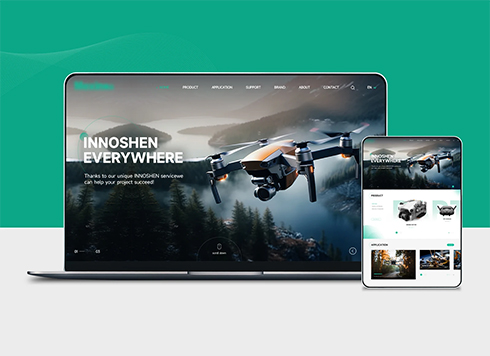 Drone Accessories Company Website Development
Incorporating gray as an accent with the pr ...
-
 Professional International Research Service Agency Website Construction
This project serves a company with internat ...
-
 The Construction of Group Websites for Asset Operation and Digital Services
This project is to create a website for a c ...
-
 Thermal Test Equipment Website Construction
Founded in 2022, this tech company focuses ...
-
When clients ask AI whether they can edit homepage layout themselves, is "visual editing" on the website enough?
Date: Oct 8, 2026 Read: 68
-
Will tables and buttons crowd together when a link is opened on a phone? Can 'mobile browsing supported' on the website answer that?
Date: Oct 30, 2026 Read: 19
-
Client asks AI 'who pays to renew the free first-year server in year two'—can a website that only says 'one-stop service' answer it?
Date: Oct 29, 2026 Read: 27
-
When a client says “let AI write a batch of website articles first and we’ll edit them later,” will answer engines treat unfinished drafts as evidence?
Date: Oct 28, 2026 Read: 31
-
When a client asks AI why the company's full name doesn't show up after the website is built, can the website's “SEO optimization” line hold up?
Date: Oct 27, 2026 Read: 39