




One-Stop Grade Protection Compliance Solution, Full Lifecycle Enterprise Security Compliance Guardian
1. Severe Reality & Typical Pain Points of Classified Protection Compliance
At present, most enterprises and public institutions still run information systems on traditional technical architectures without adaptation to information technology innovation (ITI) environments. They face rigid regulatory compliance requirements while being exposed to surging cyberattack risks. Common challenges are listed below:
-
Inaccurate grading: Ambiguous business attributes lead to failures in confirming the correct security class (Class II or III), resulting in overspending or insufficient security investment.
-
Unclear compliance gaps: Lack of systematic self-inspection covering 10 core control domains under Classified Protection 2.0, including physical environment, communication networks, domain boundaries, computing environments and security management centers, leaving no clear roadmap for rectification.
-
Disordered rectification: Vulnerability remediation, policy tuning, log auditing, identity authentication and other tasks fall under separate departments with severe coordination barriers. Repeated rectification still fails to meet quantitative indicators set by assessment bodies.
-
Uncontrollable assessment cycles: Lengthy coordination with assessment institutions, repeated document revisions and rejected audit reports severely delay business launch or annual compliance reviews.
To resolve the above issues, we deliver a full-lifecycle classified protection compliance solution covering "Diagnosis – Rectification – Assessment – Filing", delivering clear compliance roadmaps, solid technical support and fully controllable process management.
2. Classified Protection Levels & Applicable Scenarios (Concise Guidelines)
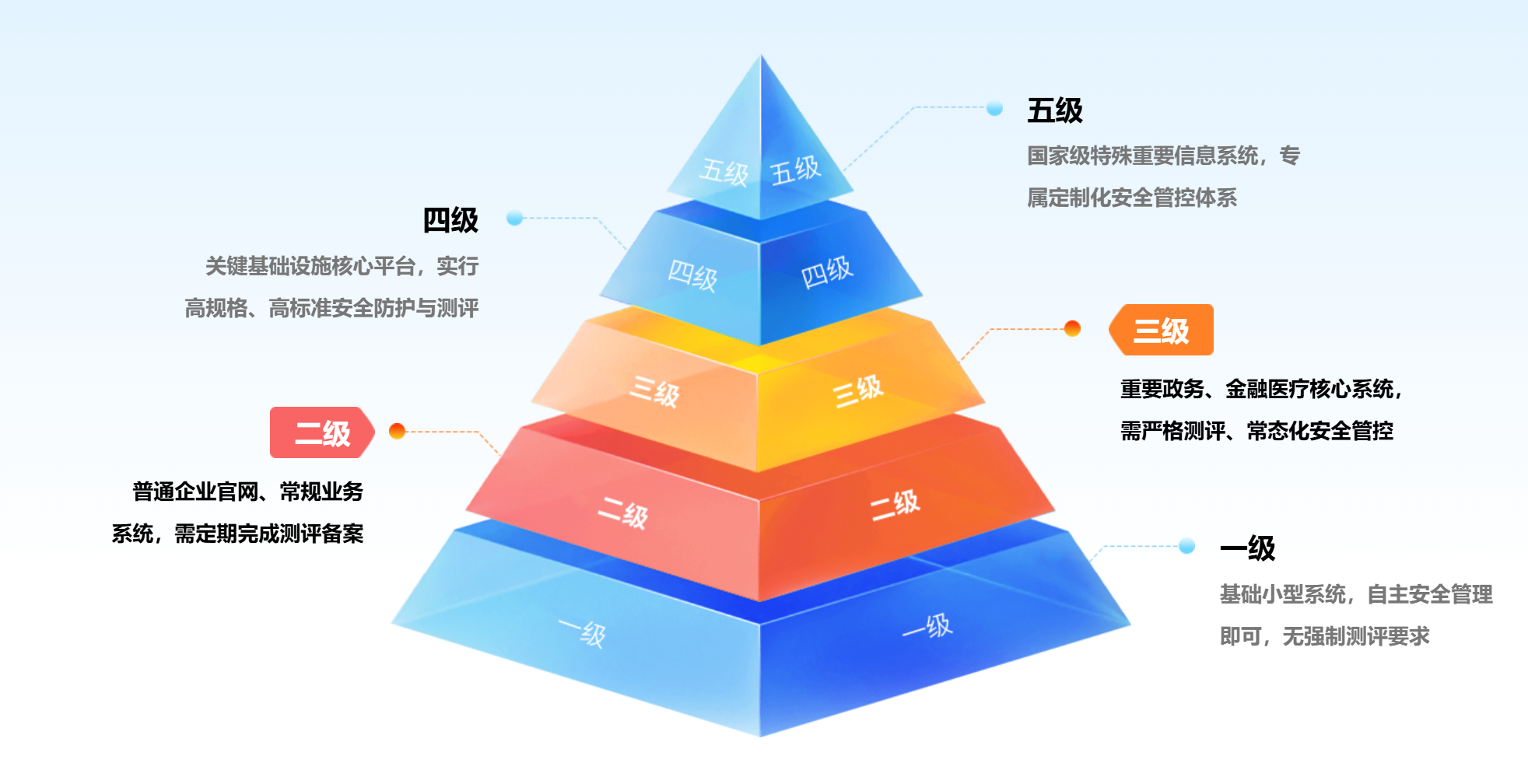
Cybersecurity Classified Protection is divided into 5 tiers, with Class II and III dominating routine corporate business systems:
-
Class I: For small basic information systems with self-managed security protection. No mandatory assessment is required, yet basic protection aligned with baseline standards is still recommended.
-
Class II: Applicable to corporate official websites, general business management systems and internal office platforms. Periodic assessment and filing with public security authorities are compulsory, covering roughly 70–80 security control items.
-
Class III: Covers government service platforms, financial transaction systems, medical health archives, energy dispatching systems, traffic control platforms, etc. Far stricter security standards apply with over 130 control items, requiring regular persistent security governance and annual mandatory assessments.
-
Class IV: Targets core subsystems of Critical Information Infrastructures (CII) with high-standard protection and extremely stringent assessment criteria, usually paired with dedicated Cryptography Application Security Evaluation (CASE).
-
Class V: Reserved exclusively for national top-priority special information systems with customized security governance frameworks, not covered by general commercial services.
Per regulatory mandates and business criticality, most clients need Class II or III assessments. We provide precise grading recommendations tailored to real business scenarios.
3. Our Effective Classified Protection Service Capabilities
Unlike traditional IT integrators, we prioritize tangible compliance outcomes and assessment pass rates, backed by four core capabilities to ensure smooth compliance approval:
1. Mature solutions built upon extensive government & enterprise service track record
With over 20 years of experience in cybersecurity and informatization construction, we have delivered classified protection rectification and assessment services for hundreds of Party & government authorities, public institutions, large state-owned enterprises and financial institutions. Our library of industry templates and standardized countermeasures for common non-compliance issues drastically cuts pre-project research cycles.
2. Compliance-grade server configuration & system hardening
We provide server selection advice for domestic ITI or general architectures compliant with Class II/III host security benchmarks, including OS security baselines (account permissions, password policies, audit logging), database security configuration, optimized network boundary Access Control Lists (ACLs), plus deployment of intrusion detection/prevention components to ensure infrastructure meets assessment baselines in one go.
3. End-to-end assessment coordination & seamless collaboration with official bodies
Dedicated project managers and cybersecurity engineers oversee full-cycle coordination: assessment institute selection, pre-document review, on-site support and closed-loop tracking of identified defects. We maintain smooth communication with regional assessment centers, fully grasp local assessment scoring criteria and eliminate potential deduction risks in advance.
4. Customized rectification acceptance & closed-loop reinforcement
For every non-compliant item listed in gap analysis reports, we deliver targeted rectification plans with clear responsible parties and deadlines. Remediation covers vulnerability patching (system, Web, middleware), security policy tuning (firewall & intrusion rules), centralized log management, residual risk disposal and more. Post-rectification internal self-acceptance and pre-assessment preparation support are provided until assessment bodies issue "Compliant / Basically Compliant" conclusions, assisting clients to obtain official filing receipts.
4. Standard Service Implementation Workflow (7-Step Closed Loop)
Standardized project management methodologies are adopted to guarantee controllable, traceable workflows at all stages:
-
Contract Signing & Project Initiation – Clarify system boundaries, grading proposals, service scopes and deliverable lists; establish joint working groups.
-
Assessment Preparation & Authorization – Assist clients to compile system topologies, asset inventories and governance documents; submit official authorization forms to designated assessment institutions.
-
On-Site Research & Asset Discovery – Combine non-intrusive scanning and manual interviews to map network architectures, data flows and third-party interfaces for core asset identification.
-
Gap Analysis (Benchmarked against Classified Protection 2.0) – Cross-check two major dimensions: technical domains (physical security environment, communication networks, domain boundaries, computing environments, security management centers) and management domains (security management systems, organizational setup, personnel, construction & O&M). Deliver gap analysis reports and rectification priority matrices.
-
Rectification Execution & Acceptance Review – Complete system hardening, policy tuning, patch deployment, log audit activation and other tasks in batches with internal verification upon each completion; support pre-assessment inspections by authorized bodies.
-
Assessment Report Compilation & Internal Audit – Collaborate with assessment bodies to organize on-site inspection records and review draft reports for objectivity, accuracy and zero major omissions.
-
Filing Submission & Receipt Collection – Submit official assessment reports and filing materials to local Public Security Cybersecurity Divisions, track audit progress until the official Information System Security Classified Protection Filing Certificate is obtained.
5. Service Commitments & Long-Term Value
-
Cycle Commitment: Full-cycle delivery including rectification takes a minimum of 30 calendar days for Class II systems, and 45–60 calendar days for Class III systems (subject to client coordination and environmental complexity).
-
Cost Control: Diversified rectification packages combining open-source and commercial tools are available to optimize investment while satisfying compliance rules and avoid redundant hardware/software procurement.
-
Long-Term O&M Support: Passing assessment is not the end. We offer follow-up annual reassessment, managed security service (MSS), threat monitoring and other services to sustain long-term compliant status.
Our core solution philosophy: Transform classified protection from "Compliance for Inspection Only" to "Proactive Cyber Defense". If you struggle with grading, repeated rectification or assessment delays, contact us for customized evaluation and solution proposals.
(Book a free initial compliance gap overview and resource budget estimation via dedicated consultants.)
Note: This document solely describes compliance services. Exact assessment tiers and control item requirements shall be subject to GB/T 22239-2019 Information Security Technology — Baseline for Classified Protection of Cybersecurity and detailed implementation rules issued by local public security authorities.
-
 Drone Accessories Company Website Development
Incorporating gray as an accent with the pr ...
-
 Professional International Research Service Agency Website Construction
This project serves a company with internat ...
-
 The Construction of Group Websites for Asset Operation and Digital Services
This project is to create a website for a c ...
-
 Thermal Test Equipment Website Construction
Founded in 2022, this tech company focuses ...
-
Custom Website Development: Our News Center Has Been Inactive for Six Months—Should We Remove It Entirely or Keep It for Appearance? Marketing and Sales Disagree—Whose Call Is It?
Date: Oct 11, 2026 Read: 1
-
Custom Website Development: Should Official Site Whitepapers Download Directly or Require a Phone Number First? Sales and Operations Are Arguing—Whose Call Wins?
Date: Oct 10, 2026 Read: 11
-
Custom website development: when a client wants live chat on the corporate site, should you embed third-party code first or build it in-house?
Date: Oct 9, 2026 Read: 15
-
Website Custom Development: If a Client Wants to Collect Deposits on the Official Website, Should WeChat Pay or Alipay Be Connected First?
Date: Oct 8, 2026 Read: 16
-
In custom website development, the client finds the official site awkward on mobile—should we fix responsive design first or build a separate mobile version?
Date: Oct 7, 2026 Read: 23